
The Crown Signia is the second and final iteration of the Crown in Canada. In its homeland of Japan, it’s known as the Crown Estate but it’s essentially a wagon variant that mimics the size and proportions of a Subaru Outback and Volvo V60 Cross Country. You can read our review of the Crown ‘Crossover’-type’ by clicking here, but we’ll quickly fire off some of the key differences.

For starters, the Crown Signia costs $3,063 more than the regular Crown but it comes with a larger cargo bay, a more spacious interior, and 21-inch wheels instead of 19s. It’s a Venza replacement and shares a similar soft appearance. In our eyes, the Signia is the more handsome sibling thanks to an elongated roofline that stretches its proportions nicely into a taut and slimmed-down figure. Although it’s difficult to tell in both photos and in person, the Crown Signia is 50mm shorter than the Crossover, but it’s also 40mm wider and 86mm taller. There is less black body cladding around the wheel arches and fenders, giving it a more sophisticated and mature appearance. Unsurprisingly, the Signia carries an extra 105kg weight penalty and along with the larger wheels, should impact its fuel efficiency.

Those unfamiliar with the Crown nameplate shouldn’t be surprised. Despite being the second-longest-running nameplate from Japan, second only to the Land Cruiser, the Crown isn’t a household name in Canada. It is in Asia, however. Anyone who has been to the land of gachapons and geishas will have undoubtedly seen one, maybe even sat in one unaware of its legacy. Self-operating doors, winged mirrors budding out the rust-free fenders, an interior furnished like a 90s nursing home, and a suited-up gentleman wearing pristine white gloves – you guessed it. Japan’s iconic and respected taxi and police car is a Crown. And after a lengthy 40-year hiatus, the Crown is finally back on the Canadian market.

We wish they used the Crown badges, as they still do in Japan, instead of the lettered script here. That would strengthen its identifiable lineage and solidify its position as a reputable sub-brand. They also get a cooler-looking key fob. The Crown has so much untapped potential, but we don’t think the creators realize how much Westerners idolize Japanese history and culture.

The Signia’s stretched-out roof has remedied many ergonomic issues related to the rear seat and cargo bay area. The entry door portals are larger, making it easier to clamber in and out of the Signia than the regular Crown. We complained about the latter’s awfully poor rear seat leg- and headroom, but this wagon variant stretches out that roofline right to the trunk lid, meaning we now have copious amounts of room to stretch and wiggle about.

I can sit behind my six-foot self with ease, and although my knees are grazing the front seatback, my hair remains pristine. The rear seats are mildly reclined and not too elevated, the seat cushions are supportive and heated, and the third window behind the headrest makes all the difference in terms of cabin openness and natural light seeping in. These second-row seats can also be folded down but they’re not entirely flat and flush with the cargo floor and are angled slightly upwards. There’s a sizable sunroof divided into two panels that lets in a considerable amount of light, brightening up this blacked-out cabin spec, but it’s fixed and cannot open. Worse yet and like the crossover, it cuts significant amounts of precious headroom from the front cabin, meaning there’s more headroom in the back than there is in the front.

Still, this kind of capability and functionality is what we expected and wanted from the famed Japanese taxi, not the cramped atmosphere that we experienced in the crossover. However, that’s not entirely fair, as the Crown is offered in four different variants, just not in Canada. Dig a little deeper, more specifically, dig to the other side of the world, and you will find the two other variants of the 16th-generation Crown.
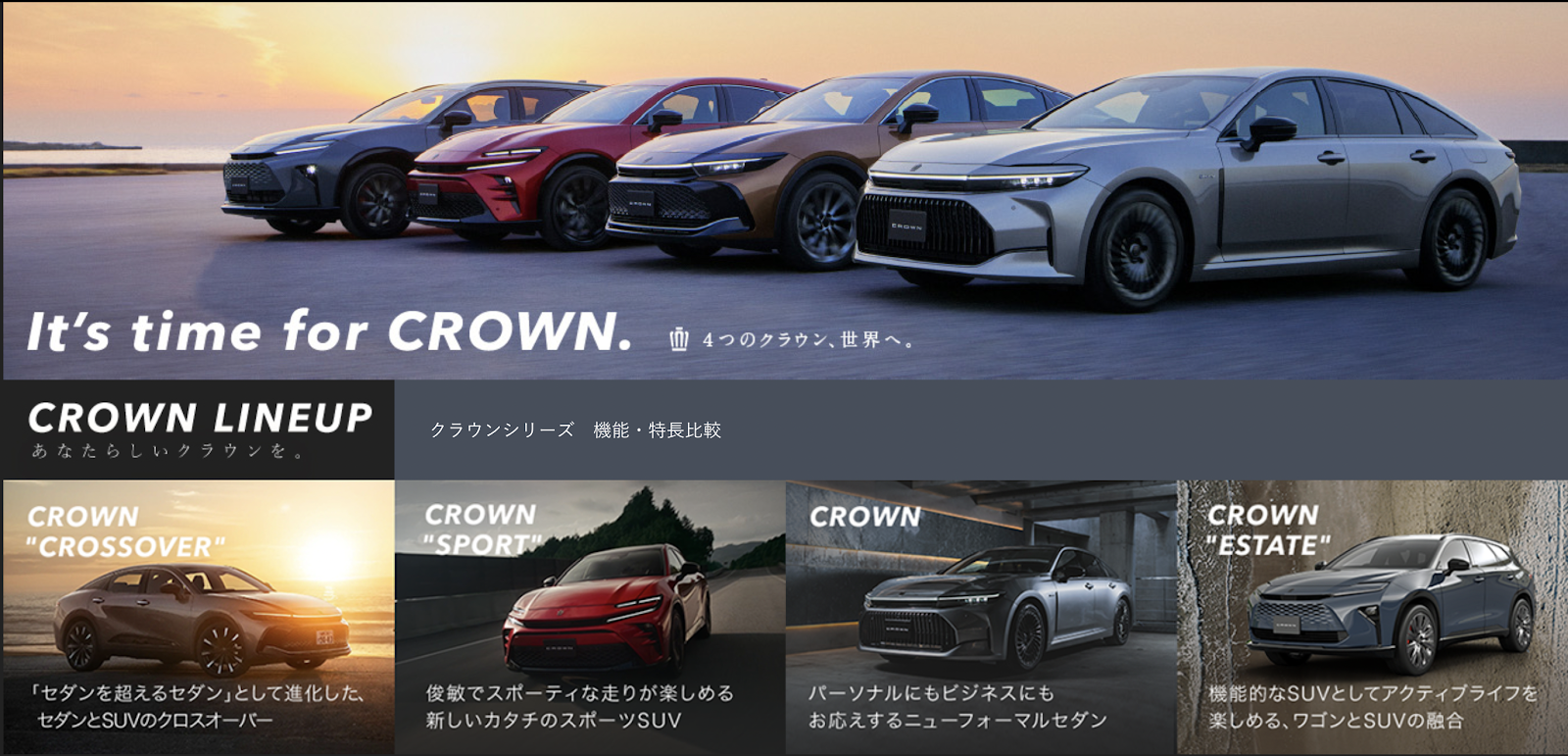
These two remain forbidden fruit. The Crown Sedan is a chauffeur-focused limousine that utilizes a considerably longer wheelbase. This RWD-only Sedan boasts a gorgeous side profile and a palatial rear cabin replete with larger headrests, manual sunshades, and a touchscreen embedded in the center armrest. The second is the Crown SUV, smaller than the Signia but it looks like Japan’s take on the Ferrari Purosangue. Feeling shafted? We do too but we have no right to complain. Nobody bought the Toyota Avalon, Lexus LS 500, or Genesis G90. You can check out Toyota Japan’s website for the full comparison between the four models.

Otherwise, the interior of the Crown Signia is genuinely the most Lexus-like Toyota we’ve ever seen. Quiet luxury is the name of the game, both figuratively and literally thanks to acoustic glass and liberal use of sound-deadening materials that keep tire and wind noise to a minimum. Swaths of low-grade leather and cleverly masked black plastics give the sense that this is a slightly more upscale product than the run-of-the-mill Camry, akin to transitioning from No Frills to Loblaws. With a starting price of just under $60,000, it had better but the amenity list is generous with standard heated and ventilated front seats, wireless phone charging, leather seats, and an 11-speaker JBL audio system.

The 12.3-inch touchscreen offers excellent resolution and is perfectly positioned for easy reach. The switchgear throughout is sturdy and well-made, similar to the top-shelf buttons found in the Mazda CX-50. The switches offer excellent registration and feedback and don’t wiggle in their slot like the laughably loose ones in the $90,000 Acura ZDX. We also enjoy using the new gear shifter, a design inspired by the Lexus LC 500. Its compact lever doesn’t take up much real estate, leaving the center console open for sizable cupholders and a vertical wireless charging pad that takes up significantly less room than a flat one but it’s like dropping your phone into a deep abyss every time.

The Crown offers decent visibility all around due to its raised seating position, but like the crossover, the JBL speaker on the A-pillar protrudes like an aftermarket add-on, mildly obstructing the left-side view. Creature comforts typically found in luxury cars, such as keyless entry on all four doors, automatic rain-sensing wipers, and rear heated seats, are standard here, but the lack of a power-operated trunk constantly reminds us of its humble origins. Other notable foibles include the auto brake hold function annoyingly resetting after each ignition cycle, the weakest heated seats we’ve ever experienced, and the steering wheel’s heating function omitting the 11-, 12-, 1-, and 6-o’clock positions.

The Crown Signia is offered in one trim only: Limited. As such, it utilizes Toyota’s standard hybrid setup, featuring a 2.5-litre four-cylinder engine paired with two electric motors – one on each axle for an all-wheel drive configuration – and an electronic continuously variable transmission (e-CVT), resulting in a combined output of 236 hp. Of note, the Signia does not come with the more powerful 340-hp turbocharged 2.4-litre engine found in the Crown Platinum ‘Crossover’, nor the adaptive suspension or rear wheel steering. But it doesn’t particularly need them either.

Compared to the rivalling Subaru Outback, the Crown Signia has better road manners and feels more refined and premium on the road. It’s not as raw or rugged, nor does it evoke the same Subaru vibes of wanting to explore off-road, but it effectively glides through town with a confident stride and would make for a compelling and fuel-efficient road trip companion.

Languid acceleration and numb steering hinder the Crown from winning any performance accolades, but we didn’t expect as much. Its mojo is instead about offering an efficient, reliable, comfortable, and slightly more regal experience than a Camry or RAV4. The ride is pleasantly soft and plush, exactly as prescribed, even without the adaptive suspension, and will surprise and satisfy those trading in their German luxury sedans in search of lower maintenance costs but with a similar ride and feel.

Disappointingly, the 2.5-litre engine is thrashy and makes unpleasant noises when cold or under heavy demand and could benefit from more firewall insulation. But it’s the whining from the electric motors that annoys us the most. It whistles up and down during acceleration and brake regeneration, frustratingly mimicking a police siren, and leading us to frantically search our mirrors for the invisible cop car on our tail. Granted, you will only hear it when the audio volume is low or turned off completely, but it’s there.

Efficiency is the ace up the Signia’s sleeve, but its larger 21-inch tires and weight penalty mean it’s not as efficient as the Crossover. Judicious throttle application coupled with as much lift and coast as possible yielded us a still impressive 7.5 L/100km, compared to the 6.5 L/100km we achieved in the regular Crown. This was in temperature hovering a few digits above and below 0 degrees Celsius with cabin heaters on full blast, mind and is perhaps the reason why Toyota claims a more favourable 6.2 L/100km combined rating instead. Be that as it may, this hybrid favours EV mode more than before, and is less hesitant to fire up the engine right away. 60 km/h streets are where the Crown is most efficient, taking advantage of EV mode for light cruising. Trying not to wake the combustion dragon becomes an amusing video game-like challenge that rewards a shrewd right foot and the payoff of a heavier wallet.

The Crown Signia remedies many of the issues we had with the Crossover variant, primarily with rear seat headroom and cargo space, and it backs up its higher-grade material quality with a plush ride and a generous amenity list. The Crown’s storied history as Japan’s favoured taxi should help push this nameplate into Canada’s mainstream market and serve as a regal alternative to those shopping for an Outback or V60 Cross Country.
Specifications:
Model: 2025 Toyota Crown Signia Limited
Paint Type: Finish Line Red
Base Price: $57,450
Price as Tested: $60,335
Wheelbase(mm): 2,850
Length/Width/Height (mm): 4,930/1,880/1,625
Curb Weight (kg): 1,909 kg
Powertrain: 2.5-litre four-cylinder, two electric motors, nickel-metal hydride battery
Horsepower: 236 combined hp
Transmission: eCVT
Engine & Drive Configuration: Front engine, eAWD
Observed Fuel Economy (L/100km): 7.5
Tires: Pirelli Scorpion Winter 2; 235/45R21



Leave a Reply