
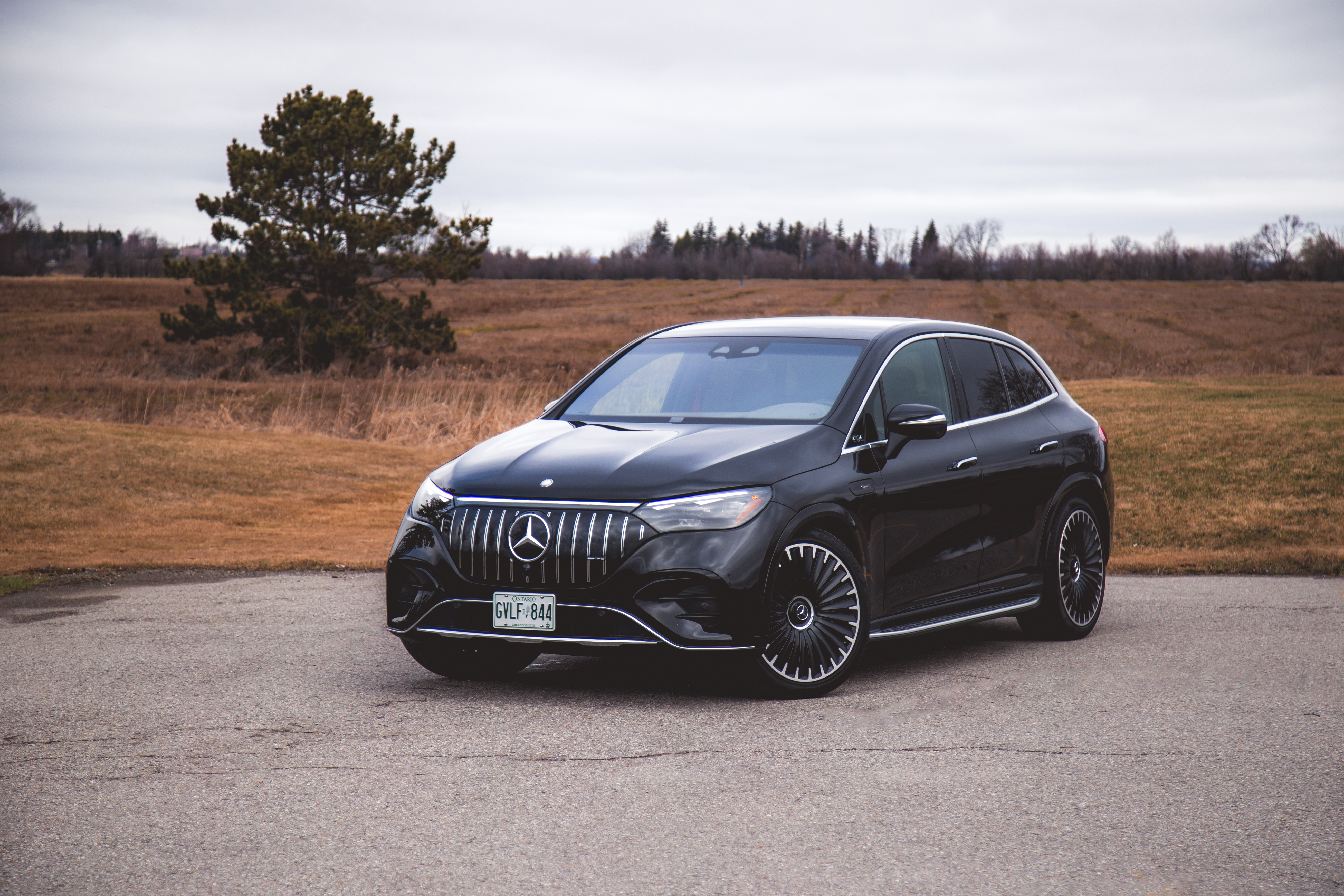
We’ve never warmed up to the current crop of Mercedes EQ sedans. The latest one we drove was the AMG EQE Sedan, a four-door electric sled capable of slingshotting from 0-100 km/h faster than a Porsche 911 Carrera S while emitting nothing but fairy dust and a green conscience. But it lacked cohesion, it wasn’t enticing to drive, the brakes lacked consistency, and we never found a way to gel with it on any road. The sedan is a perplexing offering from AMG but we’d argue that the SUV equivalent is the better vehicle.

The 2024 Mercedes-AMG EQE SUV costs $7,400 more than the Sedan but for good reason. The SUV receives larger wheels, different steering and suspension tuning, rear-axle steering that can rotate the wheels 9.0 degrees instead of 3.6 degrees on the sedan, and even a new Off-Road mode. Instead of the sedan’s conventional anti-roll bars, the SUV uses electromechanical active roll stabilization, which should reduce body roll and aid in ride comfort. Range has also increased to 378 km compared to the sedan’s 362 km. Of note, in other parts of the world, it is called the EQE 53 but since we don’t expect a hairier version, Mercedes has just coined it the Mercedes-AMG EQE in Canada.

But no matter what you call it, this SUV is blindingly quick. It utilizes the same electric powertrain as the sedan, which consists of a 90.6 kWh battery and two electric motors. The EQE generates an eye-watering 617 hp and 701 lb-ft of torque but that output isn’t always readily available and depends on the selected driving mode. AMG was gracious enough to send us a chart:
| AMG EQE SUV | |
| Slippery | 50% output (308 hp) |
| Comfort | 80% output (493 hp) |
| Sport | 90% output (555 hp) |
| Sport+ | 100% output (617 hp) |
| RACE START without Boost function | 100% output (617 hp) |
| RACE START with Boost function | 110% output (677 hp) |
As you can see, Sport+ allows for 100% power while the others dial that percentage down in the name of efficiency. Optioning the AMG Dynamic Plus Package adds a RACE START mode, otherwise known as launch control, which temporarily bumps the output to a staggering 677 hp and 738 lb-ft, allowing the EQE to sprint from 0-100 km/h in 3.5 seconds, the same as the sedan and quicker than the BMW iX M60 (3.8s) and Audi SQ8 e-tron (4.6s).

With the AMG comes a litany of performance equipment like an adaptive air suspension and 22-inch wheels (21-inch wheels are standard fare) but like the sedan, the AMG’s point-to-point pace was never in doubt. Rather, the build-up, play, and cohesion between those points are lacking. It doesn’t tempt us to drive fast.

The SUV does offer more confidence to brake late, steer more, and coax the rear to finally let go of its tight reins, but not by a considerable amount. Maybe it’s because of the higher seating position, or the noticeable reduction in body roll thanks to the new electric anti-roll bars that AMG calls Active Ride Control. Maybe it’s the extra 115 kg of weight it’s lugging around versus the sedan, that better grounds it to the tarmac, or perhaps it’s the new suspension tuning to account for the higher ride height and elevated center of gravity. Or maybe because it isn’t trying so hard to be a super sports sedan ready to outrun a Bugatti Chiron at all costs.

The steering carries with it heavy vibrations from the front tires at higher speeds, less so at creeping speeds. But it makes the SUV feel more alive, like it’s breathing with the road underneath and developing a rhythm. The large low-profile 22-inch tires are certainly to blame for this – the sedan wears 20-inch shoes by comparison, and those provide a more cosseting and absorbent ride as a result. The SUV is stiffer and doesn’t isolate pockmarked roads or bumps as effectively.

That said, its movements will feel unnatural for the first few hours behind the wheel – forced, hypersensitive and hyperresponsive, like someone turned up your mouse sensitivity to 150%. The rear axle steering further augments that sense of agility and nervousness, making it off-puttingly agile for its size but it takes quite a while to acclimatize to its habits, certainly more than any gas-powered car. The learning curve is steep but I’m not so sure that the reward is worth the trouble. The BMW iX M60 may be slower but it is easier to get cozy with and is a more complete driver’s SUV with a lower learning curve. The same goes for the Audi SQ8 e-tron.

Like the sedan, the brakes and the brake pedal are the weakest areas of this AMG. In fact, the SUV’s heavier weight highlights the inconsistent brake pedal even more. The pedal is springy, non-linear, and difficult to modulate smoothly. There’s little slack and tolerance in pedal movement. If you lift your foot by a millimetre the vehicle throws itself backwards to regenerate energy. The unmanageable inertia disconnects us, an odd feeling when this is marketed as a driver’s SUV. A quick remedy for this was flipping the paddle shifters between strong and zero regen and using that as a substitute for the brake pedal. Though not as convenient, stopping action was certainly smoother and more predictable. Another remedy? Drive faster and brake harder. The brakes are well-suited for aggressive driving but not for the mundane stop-and-go traffic that the majority of these EQE AMGs will inevitably be tasked with.

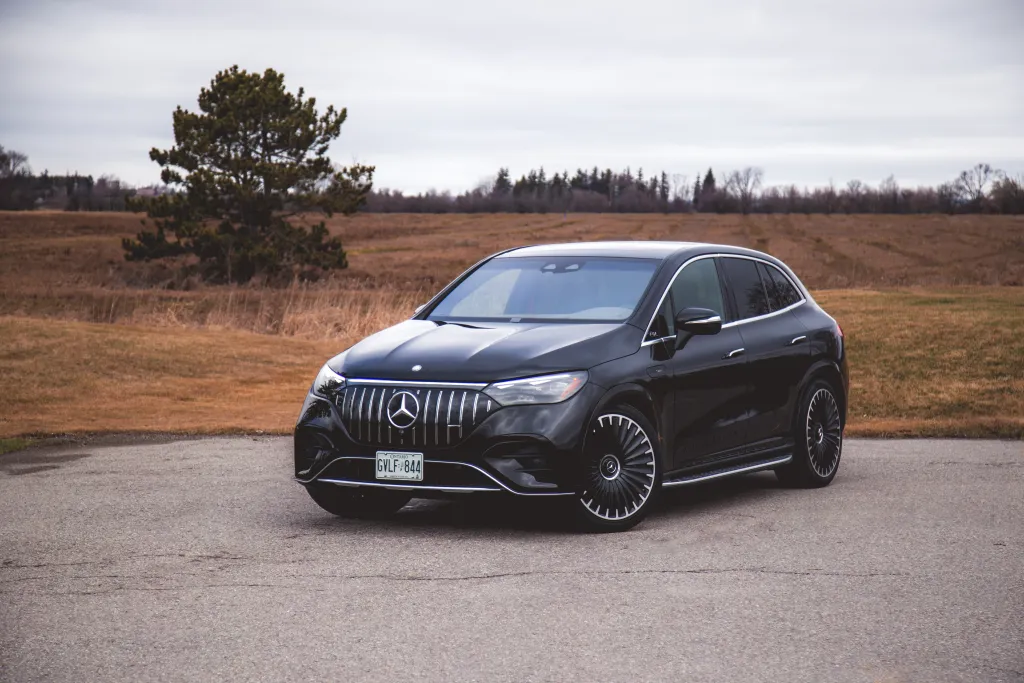
While the EQ sedans are shaped like teardrops, their SUVs are much more visually balanced. Their larger silhouettes give more visual mass and a muscular stance. But whatever you do, skip the running board option, as they are annoyingly too thin to be useful, but wide enough to always dirty the back of your pants when stepping out of the vehicle.

The AMG’s signature front grill and its hot-stamped vertical lines in chrome have us constantly looking over our shoulders after we’ve parked. When dressed in Obsidian Black with matching 22-inch turbine wheels ($1,755), the EQE AMG looks as sharp as a tailored striped tuxedo. Of note, MY2024 AMG models come with an Affalterbach badge on the front hood instead of the traditional Mercedes silver star.

The interior is more spacious than the sedan. My six-foot figure had no issue in the sedan’s five available seats, but head and leg-room are much more generous in the SUV, as is the trunk volume. Unlike the sedan’s mailbox-slit rear windshield, you can actually see out of the SUV’s. Our EQE also came with a more convincingly sporty spec with carbon fibre panels, red seat belts, and a suede and leather steering wheel ($650) which we highly recommend.

The SUV is the superior product but not by a country mile. It’s easier to feel connected to and is a more cohesive product thanks to reduced body roll and grittier steering. However, the SUV is still half-baked in many areas like brake consistency, road handling, and range, hardships that we don’t find worth enduring, leading us to highly recommend the products that AMG does best instead: its combustion offerings like the GLE 53.
Specifications:
Model: 2024 Mercedes-AMG EQE 4MATIC+ SUV
Paint Type: Obsidian Black
Base Price: $128,900
Price as Tested: $148,925
Wheelbase(mm): 3,030
Length/Width/Height (mm): 4,879 / 2,141 / 1,669
Curb weight (kg): 2,626
Powertrain: 90.6 kWh lithium-ion battery, two electric motors
Horsepower: 617 hp (677 temporary hp in RACE START mode)
Torque: 701 lb-ft (738 temporary lb-ft in RACE START mode)
Transmission: Single-speed automatic
Claimed Range: 378 km
Observed Range: 301 km
Tires: 22-inch



Leave a Reply