
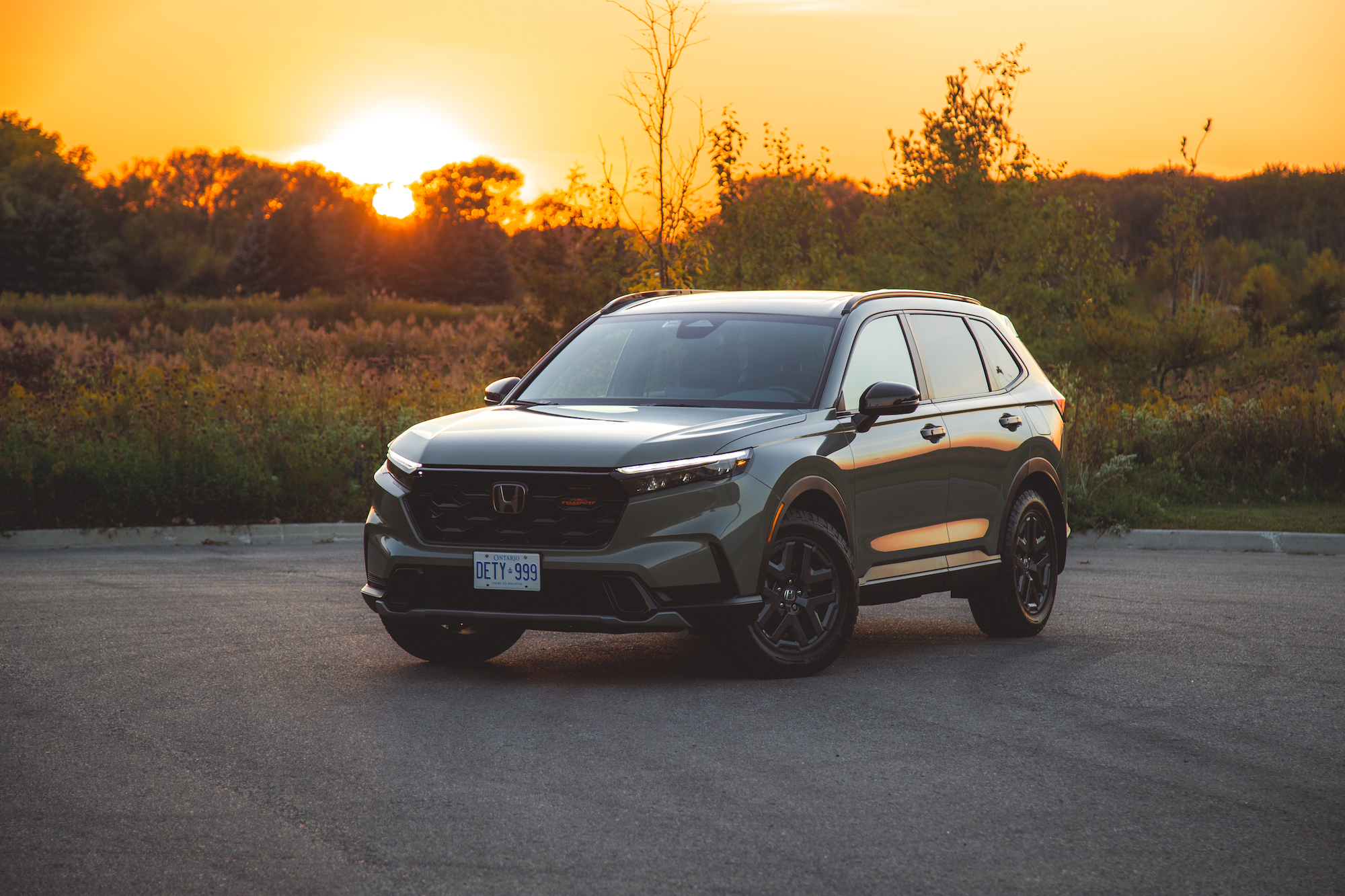
The Honda Passport has always been a CAR favourite for its honest V6, exemplary driving dynamics, spacious and ergonomically sound cabin, and attractive price point. This fully redesigned 2026 model aims to continue that trend with a rugged new appearance, larger dimensions, and a TrailSport package that adds off-road capability, improved ground clearance, and larger tires.

In fact, the new silhouette bears almost no resemblance to the outgoing Passport. It adopts that trendy, muscular, geometric shape permeating the market. Think G-Wagon, 4Runner, Defender, Bronco. They all have blocky shoulders and cubic shadows, and buyers are soaking it all up. Much like fashion trends, automotive design really does work in cycles. But we enjoy the Passport’s more humanoid face, like a grown-up Honda Element in pumpkin spec, just in time for Halloween.

The interior hasn’t strayed off course, though. It’s the same familiar layout, featuring a straightforward design that has been quietly improved and rearranged with ergonomics at the forefront, but it can appear somewhat anodyne compared to its rivals. There’s no visual drama or garnish. We love its honest look and low learning curve.

No fussy haptic touch sensors appear, and it doesn’t overrely on digital real estate either – the abundance of physical switchgear for the ventilation controls, volume, and steering wheel is hardproof. The knobs and dials also have ridges and elevations, making them easy to find and operate without taking your eyes off the road. This is user functionality done correctly, and we’re glad Honda hasn’t given in to the trend of clean, buttonless interiors. Take a look at the Volvo EX30 to see where the mania of reducing button count continues. We get Volvo’s method to the madness, reducing material usage and its overall carbon footprint, but the severe impact on user functionality makes it ineffective.

Not to mention, this is the best Honda touchscreen unit we’ve used, featuring a 12.3-inch size, crisp graphics, and wireless Apple CarPlay and Android Auto compatibility. The screen may not be as high-definition as the newest iPad, but it’s getting there. And with Google Integration, it’s even easier to command and change navigation points verbally.

For those who need more room than a CR-V but find the size of a Pilot too intimidating, the Passport is an ideal choice. There is more rear seat room and trunk space than before, thanks to the Passport’s longer wheelbase. It makes excellent use of its cavernous interior with large cubbies and easy access to them. The door panel features multiple storage compartments and there’s a massive, square center box, which is more useful than the awkward, narrow L-shaped box in the Mercedes GLC, which is unable to fit much.

To our surprise, Honda retained its naturally aspirated 3.5-litre V6, a more characterful engine than the turbocharged variants used by the Toyota 4Runner and Ford Bronco. The engine is the star of the show, a free-breathing, naturally aspirated 3.5-litre V6 that generates 285 hp and 262 lb-ft of torque through a 10-speed automatic gearbox, which is 5 hp and one extra gear more than the outgoing model. It may be an aging unit that lacks headlining power figures, especially compared to the punchier turbocharged units, but its honest power delivery and seekable top range make it a joy to rev out and utilize every horsepower in the chariot. Furthermore, it only requires 87-octane fuel.

There’s a proportional relationship between the gas pedal and forward thrust, a welcome benefit for beginner drivers and purists alike. That being said, the V6 can feel languid in the low-end, and you have to plunge your right foot into the pedal and work for your performance. Still, the drive becomes more involving and satisfying, evoking memories of Honda’s VTEC units that freely revved to the moon. The V6 emits authentic exhaust notes and a peaky intake noise, too, as if there’s one-quarter of an NSX V6 lying under the front hood. There’s that throaty, high-pitched, mechanical whine that’s playful and shows us that Honda DNA is dripping in its veins.
However, the powertrain is let down by a sluggish 10-speed gearbox that tends to stay in top gear and is hesitant to downshift. When cruising at 100 km/h, it takes approximately a full second after throttle kickdown for the gearbox to respond and downshift. It’s not the most agreeable SUV because of this, and we don’t recall the outgoing 9-speed being this delayed. Sport mode and selecting the S gear don’t help much either, but paddle shifting yourself and keeping the needle higher in the RPM range is the most rewarding way to extract performance.

A stiffer chassis and retuned suspension have also provided better road compliance and comfort. The ride is more fluid and polished, with only larger bumps and oscillations seeping through to the driver’s seat. Even on the General Grabber All-Terrain tires (275/60R18), the new Passport exhibits such pliancy and composure that it encourages you to tackle and smooth out the worst of the road surface imperfections. The ride still has a mild edge to it, but we are genuinely surprised by how grippy and quiet these tires are.

Despite its larger size, the Passport’s predictable power delivery and flat cornering make it more fun and satisfying to drive than the CR-V. The steering carries a vague on-center feel but it’s light and precise, offering a decent amount of rotational resistance. When released, the wheel will quickly spring back to a neutral position, much like the hydraulic steering racks of yesteryear.
In an attempt to mitigate body roll and introduce better dynamics, Honda equipped the Passport with a clever torque vectoring system, and I don’t mean the brake-based kind. This is true torque vectoring, meaning the differential can re-route 70% of the torque to the rear axle, and 100% of that torque to either the right or left wheels – you can view this distribution of power in real-time in the instrument cluster as well.
This allows for better handling and traction when cornering, and you can immediately feel the difference when carrying this bruiser on a speedy turn. It doesn’t bestow a newfound athleticism, however, and you still get a similar top-heavy lean that you would get in the Pilot, but it’s still more engaging than before.

The new Passport appeals to both the heart and the head with its rev-happy V6 and exemplary road compliance even in the off-road-focused TrailSport spec. We’re not too keen on the sleepy 10-speed gearbox, but its ergonomically designed interior and handsome looks make it both a commuting and road trip warrior that wouldn’t look out of place in any garage.
Specifications:
Model: 2026 Honda Passport TrailSport Touring
Paint Type: Sunset Orange II
Base Price: $60,540
Price as Tested: $60,840
Wheelbase(mm): 2,885
Length/Width/Height (mm): 4,864 / 2,019 / 1,857
Curb Weight: 2,135 kg
Powertrain: 3.5-litre V6
Horsepower: 285 hp @ 6,100 rpm
Torque: 262 lb-ft @ 5,000 rpm
Transmission: 10-speed automatic
Drive Configuration: Front engine, AWD
Observed Fuel Consumption (L/100km): 12.7
Tires: General Grabber A/T Sport; 275/60R18


Leave a Reply