
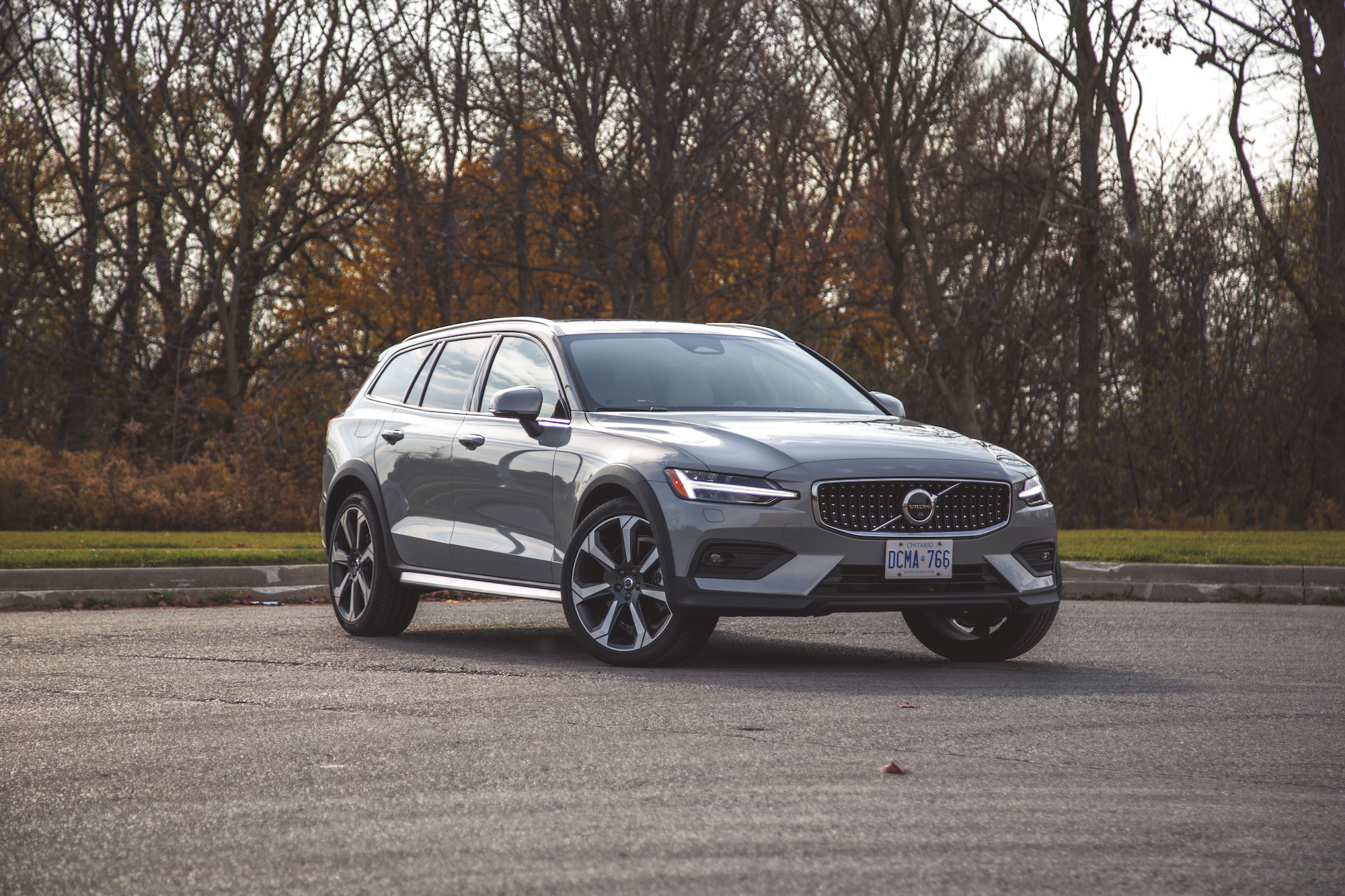
While slowly growing in popularity, wagons are still a rarity on Canadian roads. Mercedes has been one of the largest advocates, even offering AMG variants of their C-Class and E-Class wagons. Audi has been keeping the A4 Allroad alive for longer than expected and thanks to the popularity of the mighty RS 6 Avant, BMW has followed suit by offering a Touring version of their new M5. Subaru should also be credited with the Outback, and the same could also be said for Volvo in recent years with the V60 and V90.

The V60 is the compact wagon in the lineup, based on the S60 but featuring an elongated roofline, hatchback trunk, and increased cargo capacity. Currently, it only comes in Plug-in Hybrid or Cross Country trims, the latter of which raises its ride height by 60 millimetres for better ground clearance and is clad in black plastic around the bumpers and wheel arches to protect the sheetmetal, expertly blending a wagon and crossover mentality.

The added height allows for easier entry and exit from the vehicle, and also makes loading heavy cargo into the trunk less of a bending exercise for taller individuals. It provides a sense of safety for novices who prefer a higher seating position and are worried about curbing the wheels – best not to underestimate how much a few extra millimetres of ground clearance can do for your vehicle.

I admire the fact that Volvo didn’t bother slathering fancy “Cross Country” badges all over the vehicle like BMW and Mercedes do with their off-variants. Instead, there’s Cross Country lettering subtly embossed into the rear bumper. Matched with the already stylish T-shaped headlights, integrated roof rails, and a range of wheel sizes, the V60 commands more curb appeal than any of Volvo’s current SUVs.

The current-generation V60 has been around since 2019, but the largest update in recent years has been the integration of Google into the touchscreen unit, morphing this Swedish wagon into a rolling smartphone. Google Assistant, Google Maps and Google Play, you name it, it’s all here, and you can use the Volvo just as you would your Google Home or Android phone. Say ‘Hey Google’ and the Volvo will respond. You can verbally input addresses for navigation in Google Maps, or even control compatible smart home devices, such as thermostats or mood lighting. The system responds to voice commands in a flexible and open manner, and isn’t restricted to a specific set of commands. It’s a refreshing interface compared to many in-house developed navigation units, which are, let’s be frank, subpar. Hence, Apple CarPlay and Android Auto are in such high demand thanks to their clean layouts and familiar modes of user interaction. This is one of the rare instances when I actually used the in-car Google Maps rather than switching to Apple CarPlay. That’s as good of a praise as it gets.

This is all bundled into Volvo’s Digital Services Subscription, which is included in the V60 for 4 years, as well as all the data being used. This subscription follows the actual vehicle so if you sell your V60, the new owner can continue to use these Google services until the 4-year period has expired.

The rest of the V60 cabin is clean, simple, and very Scandinavian. If IKEA were to design a car interior, it would look exactly like this: minimalist with ergonomic seats, lots of bare wood, and a careful use of chrome and plastics. Every dial, knob, and button has a light and deft touch, so they do not require much effort or dexterity to operate.

Standout features include the Orrefors glass shifter, elegantly perched like a centerpiece and we’re disappointed that it hasn’t migrated to the latest crop of Volvos like the EX90. The windshield wipers also have their washer nozzles embedded within the stalk, which spray a more calculated and controlled stream down the windshield.

The V60 Cross Country is available in only one trim, equipped with the B5 engine and standard all-wheel drive. That means a turbocharged 2.0-litre inline-four delivering 247 hp and 258 lb-ft through an 8-speed automatic transmission and the ability to sprint from 0-100 km/h in 6.9 seconds, more than enough for the daily commuter.

The engine is noisy, brash, and emits a tractor-like vibration, most notably in cold weather. Power comes on gradually rather than suddenly but there’s an impressive amount of forward propulsion once the boost kicks in. Thanks to the quick and smooth 8-speed transmission that operates behind the scenes without any fuss, most of the delay is mitigated, leaving no hindrance to on-road performance. The gearbox shifts well enough that you never have to take the helm either – good thing as there are no paddle shifters available.

Volvo ensured the suspension was softened with the Cross Country variant, but the ride is still compromised by its raised ride height. Stiff and wooden when traversing over bumps, the V60 does not handle vertical movements very well and tends to crash when hitting potholes or cracked pavement. An air suspension is off the books as it would impede the amount of cargo space available, which is understandably of paramount importance to V60 owners. Still, the Cross Country lacks any significant body lean, rides smoothly when the road is smooth, and remains more composed than its SUV counterpart, the XC60.
A stylish SUV alternative, the V60 Cross Country ticks all the boxes as a family hauler with go-anywhere street cred, sufficient power output, and an ergonomic and spacious interior. The ride is busy and the engine is brash, but the integrated Google system adds that extra layer of excitement to this aging wagon, transforming it from a notable automotive appliance to a well-connected smartphone on wheels.
Specifications:
Model: 2025 Volvo V60 Cross Country Ultra
Paint Type: Vapour Grey
Base Price: $66,800
Price as Tested: $74,175
Engine: 2.0-litre turbocharged four-cylinder
Horsepower: 247 hp @ 5,400 – 5,700 rpm
Torque: 258 lb-ft @ 1,800 – 4,800 rpm
Transmission: 8-speed automatic
Engine & Drive Configuration: Front engine, AWD
Observed Fuel Consumption (L/100km): 10.8



Leave a Reply