
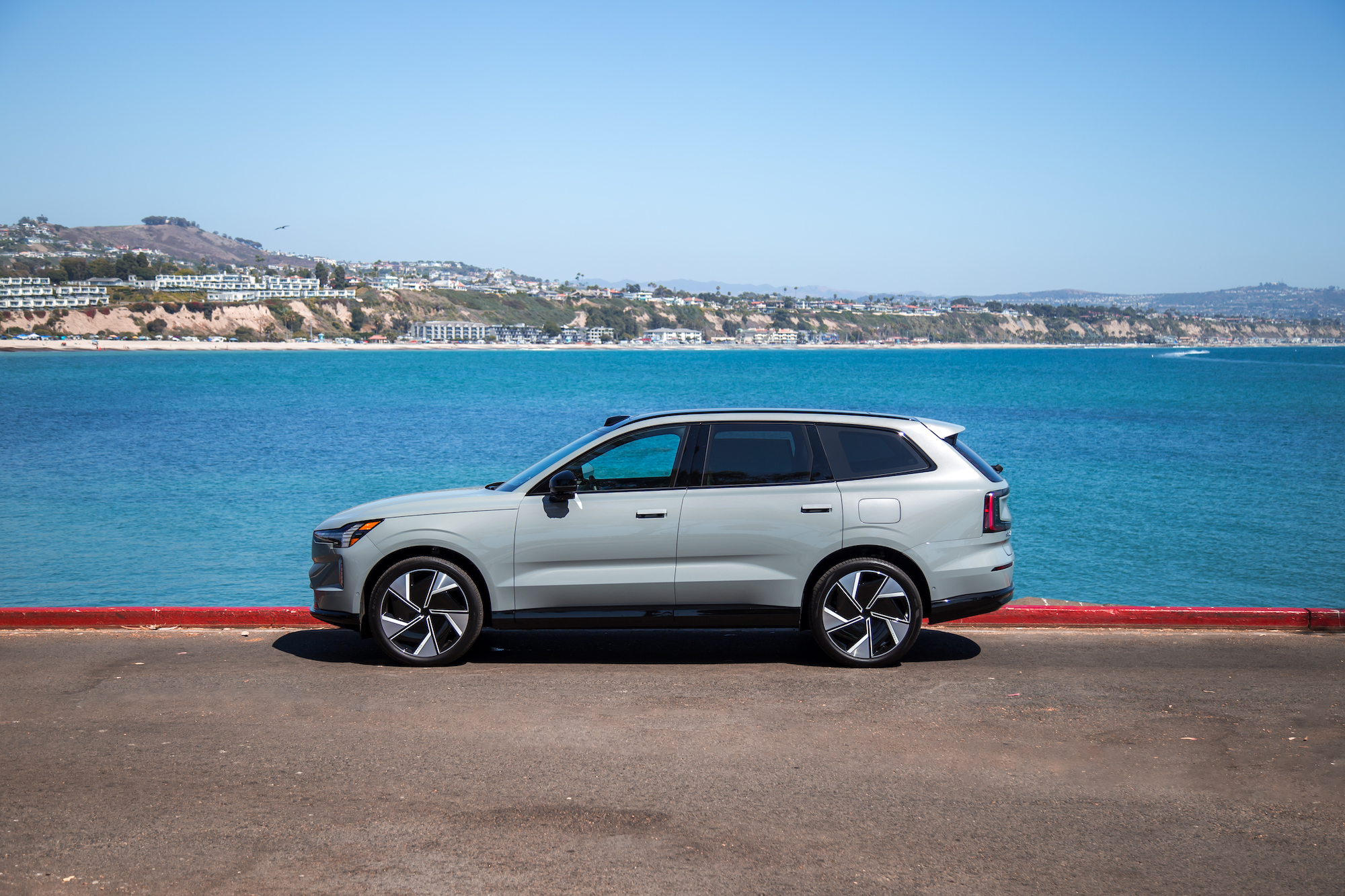
NEWPORT BEACH, Los Angeles – The second-generation XC90 changed the game for Volvo back in 2016, launching the Swedes into the spotlight with an alarmingly attractive design, a simple and clean interior, and a strong pursuit and reinforcement of what the brand was best known for: safety. The new 2025 Volvo EX90 aims to change the game again, this time by propelling Volvo into full electrification while staying true to the brand’s core focus on sustainability.

The EX90 is Volvo’s fourth fully-electric vehicle and is manufactured in Charleston, South Carolina. The EX90 is large not just in terms of proportions, but also in relation to the market in general. Three-row, seven-seater fully-electric SUVs are few and far between. The Tesla Model X, Kia EV9, Rivian R1S, and Mercedes-Benz EQB are established competitors that can swallow seven but buyers are itching for more variety, especially from mainstream brands.

What an entrance, then, to this small club. The EX90 is nail-bitingly gorgeous and both distinctive and attractive thanks to a closed-off front grill, frameless side mirrors, and an evolution of the ‘Thor’s Hammer’ headlights. There is even a pop-up cover for the headlights when the high beams are activated—a neat party trick that brings us back to the 90s.

The silhouette is elegant like a piece of West Elm street furniture that just so happens to double as a mode of transportation, but a bulge on its windshield forehead somewhat hinders the shape. This houses the vehicle’s LIDAR detection system, which aids in driver assistance features. There are eight paint colours, all muted and neutral, befitting of the brand’s look. Hence, bright and garish colours are omitted, with Vapour Grey on our test vehicle and its limestone hue standing out tremendously well against Orange County’s blue oceans and crimson skies.

The interior is a high-water mark, with Volvo prioritizing minimalism and functionality over gimmicky features and novelty items. Less Mercedes Hyperscreen, and more Marie Kondo. The dashboard is clean and simple, bordering on the level of minimalism seen in Tesla’s designs, but there are some notable details. The gear shifter has been relocated to the steering column, similar to the Mercedes EQS, freeing up center console space and allowing Volvo to integrate a large wireless charging pad and multiple cupholders. Don’t ask why its floating design eerily mirrors the BMW iX, but we salute the departure of the Orrefors crystal gear shifters. We hope the upcoming XC90 refresh will retain this novelty item.

The lack of hard buttons and switches is alarming, as much of the car’s functionality has been relegated to the touchscreen, including the side mirror controls and steering wheel adjustment. It’s an irritating trend but thankfully, one of those actions you generally do once, set to memory, and never have to do again. Luckily, the sizable infotainment screen is responsive and easy to use, featuring widgets and a fixed shortcut bar at the bottom to handle your needs. Those familiar with an Android interface will feel right at home.

There is also a digital screen that flanks the steering wheel, much like in the Ford Mustang Mach-E, but this one is higher in definition and can be customized to display navigation maps or a speedometer. Standard features are plentiful on the EX90, including a head-up display, 360-degree camera, the entire suite of driver assistance features, a fixed panoramic roof, and a cabin air purifier.

Hopping onto the wool-blend seats is like receiving a warm Nordic hug, bolstered from all sides like a Herman Miller chair. The material is not only sustainable but also incredibly comfortable and of high quality in texture and feel. The massage function is excellent and stronger than those in the Range Rover and BMW iX. Not to mention, the headrests come with built-in speakers with the optional Bowers and Wilkins sound system, which boasts 25 speakers, 1610 watts, and Dolby Atmos. This system kept our ears happy with its crisp notes and surround sound. It’s one of the best sound systems we’ve ever tested in a vehicle. The tweeter on the dashboard adds a splash of aesthetic design too, like a piece of art on your living room table. We did notice a few glaring omissions, though. There are no ventilated seats available, no five-seater option, and no roof option that can be opened.

All EX90 models in Canada come with the same powertrain consisting of a 111 kWh lithium-ion battery and an electric motor on each axle. It produces 510 horsepower, 671 lb-ft of torque, and a 0-100 km/h time of 4.9 seconds. Canada will offer two trim levels: Plus ($110,000) and Ultra ($115,600), the latter featuring an air suspension, active chassis, soft-close doors, massage front seats, laminated rear windows, puddle lights, and 21-inch wheels. The Bowers and Wilkins system and 22-inch wheels remain standalone options.
Volvo claims 495 km of electric range pending EPA certification and an entire day of driving around Los Angeles revealed a similar 490 km range. For a large seven-seater SUV like this, that’s very impressive and should alleviate range anxiety for those still hesitant.

Our first drive impressions are largely positive. Unlike the XC60 and XC90, the EX90 rides exceptionally well even on its 22-inch wheels, flowing over poor surfaces with confidence and swallowing compressions without ever hitting the bump stops. The Ultra trim is well worth it for the air suspension alone, offering a dreamy and cloud-like ride while your back is being massaged.

On the undulating and serpentine roads east of Newport Beach, we appreciated the linearity and play in the gas and brake pedals. They don’t operate like a light switch like on other EVs, with a tremendous amount of bandwidth to adjust your inputs and ensure the drive is smooth and more importantly, predictable and consistent in movement. The steering is sharp and maybe a touch too quick and sensitive – perhaps the small diameter steering wheel makes it feel that way.

Extracting the EX90’s 510 horsepower is easy once the road straightens out, and we found it properly quick, even when jousting at triple-digit speeds where EVs tend to run out of breath and feel lethargic. The EX90 also offers one-pedal driving and an automatic function, but we always prefer to utilize both pedals for a smoother experience.

The 2025 Volvo EX90 may be an expensive offering, but it occupies a market segment that remains underutilized and hasn’t yet fully matured. The addition of Ontario’s luxury tax may be a tough pill to swallow, but don’t look past this EX90 as a cheap jab at Volvo swimming upstream. It’s a high-quality product that prioritizes both safety and sustainability. Add to that its dream-like ride that flourishes on the open road, potent yet smooth acceleration, and a well-furnished interior replete with top-shelf amenities, and it’s an easy recommendation for those shopping for a fashionable zero-emission carriage.
Specifications:
Model: 2025 Volvo EX90 Ultra
Paint Type: Vapour Grey
Base Price: $115,600
Wheelbase(mm): 2,985
Length/Width/Height (mm): 5,037 / 1,964 / 1,747
Curb weight (kg): 2,747
Powertrain: 111 kWh lithium-ion battery, two electric motors
Horsepower: 510 hp
Torque: 671 lb-ft
Drive Configuration: Dual electric motors, AWD
Claimed Range: 495 km
Tires: 22-inch Euro-spec summer tires





Leave a Reply