
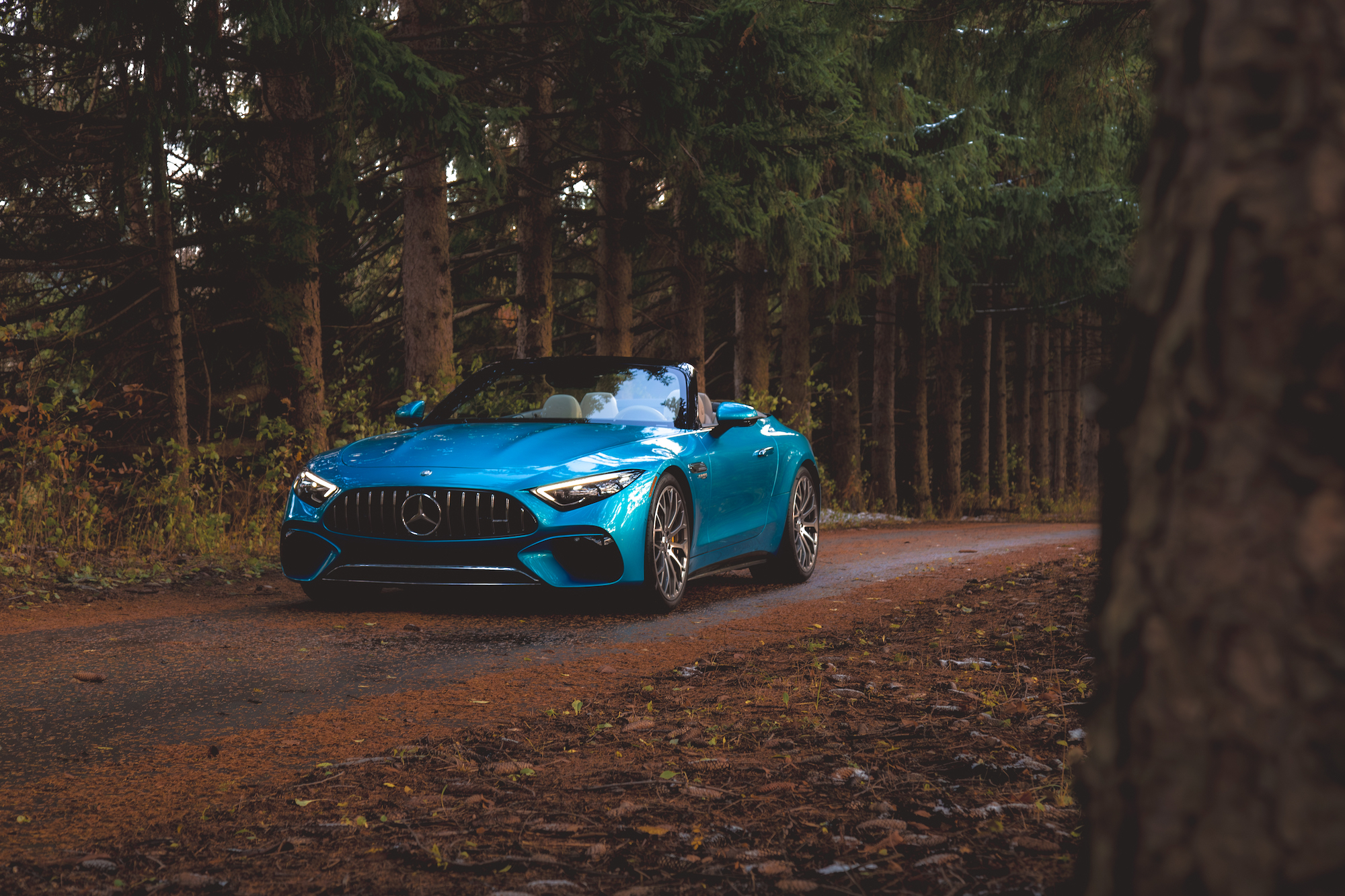
Reinventing the “Sport-Leicht” formula (or “Sport Light” in English), the latest seventh-generation SL now features 2+2 seating, a fabric roof, all-wheel drive, a more youthful design, and the choice of both four- and eight-cylinder engines. More importantly, the SL 55 badge is back for the first time since the mid-2000s.

The GT and SL are the only two that use the double-five numerals, while all other Mercedes and AMG vehicles utilize 53 and 550 instead. While arbitrary in meaning, the 55 ($172,500) refers to its 4.0-litre twin-turbocharged, hand-built V8 that generates 469 hp and 516 lb-ft of torque through a 9-speed multi-clutch transmission. The SL also comes in three other flavours: SL 63 ($225,000) with the same V8 but with an additional 108 hp and 74 lb-ft of torque, a lighter-seasoned SL 43 ($132,900) equipped with the 416 hp turbo-four from the CLA 45 S, and the lavish Maybach SL 680 ($315,000) with more logos than stars in the sky. No V12, though, but other markets offer an E Performance plug-in hybrid.


Though the SL 55 is 20 kg lighter and slower from 0-100 km/h (3.9 s) than the SL 63 (3.6 s), the differences are almost imperceptible behind the wheel, made up for by a lionheart engine that blazes away like a blacksmith’s forge, propelling the SL 55 into the distance faster than a zoom lens. We’re not sure if this M177 engine gets better with each drive, or whether the competition is dishing out smaller engines with less charisma and character, but its dynamic bandwidth and heaps of low- and mid-range muscle put it up there with some of the greats. Notably, Aston Martin also employs the M177 in the Vantage and DB12, and we’ve had nothing but positive praise for its application in those stellar examples as well.

The rolling thunder soundtrack alone justifies the upgrade from the SL 43. Firing up the ignition releases a seismic roar from the V8 before settling into a gentler, throbbing idle. An omnipresent growl grows louder with every inch of pedal travel until you reach the redline, where it then releases an artillery salvo of pops and bangs, a welcome reminder that your extra coin went to good use. The volume and pitch are indistinguishable from the SL 63, but it’s certainly louder than the GT 55, as there’s less insulation from the Roadster’s fabric roof.


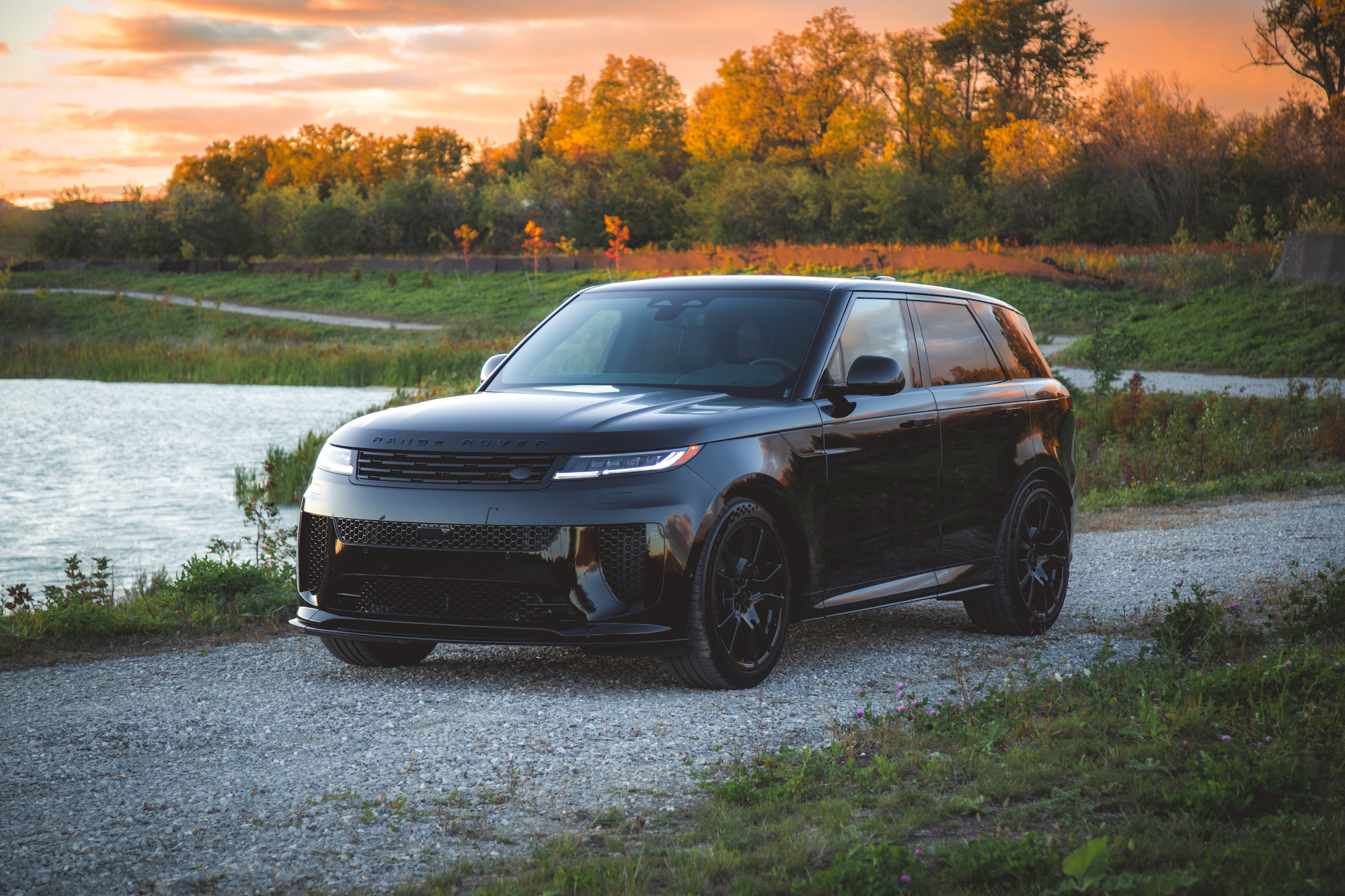
Though less well-equipped than the 63, the SL 55 still comes with notable standard features such as rear-wheel steering that allows up to 2.5 degrees of rotation, 3-stage adaptive dampers, and an AWD system that can send 100% of torque to the rear wheels. However, the options list lets you build the 55 up to a similar performance window. Our SL 55 came with the Performance Package ($6,900), which equips an e-LSD, front-axle lift, Race driving mode with minimal ESP intervention, yellow brake callipers, dynamic engine mounts, and what AMG calls Active Ride Control. The latter is an anti-roll bar system that connects all four shock absorbers via a hydraulic system rather than mechanical torsion bars, greatly reducing pitch, yaw, and roll. Land Rover uses the same concept in their Defender OCTA and Range Rover Sport SV, and McLaren as well in the 750S.

The result is excellent road compliance and reduced body roll. The SL 55 stays remarkably flat under rotation and rides with slightly more plush and polish than the GT 55 Coupe, but not at the same calibre as the Aston Martin Vantage Roadster. There’s an underlying firmness that alludes to AMG’s sporting intentions, but the SL still soaks up bumps without punishing your life choices. Thanks to an expertly tuned rear-wheel steering system, the back end rotates on a dime and is progressive enough that it doesn’t require as many steering corrections as in the overly reactive AMG EQ models. The steering still carries a synthetic vagueness that disconnects the driver from the powertrain, but it’s easy to place the nose accurately and settle into a gentle rhythm along a snaking road.

Be that as it may, our SL 55 wore Pirelli P Zero summer tires, and they struggled to provide abundant grip in our single-digit temperatures. Being unable to exploit its full performance envelope wasn’t a downer, as we expect most SLs to be driven around in more casual commuting missions where they excel at creating road presence. Notably, we never found much use for the front-axle lift, as the SL doesn’t ride terribly low, so it’s not as scrape-prone as you might expect. It’s still useful if steep ramps or inclined driveways are part of your daily route.


Though it shares the same platform as the AMG GT Coupe, the SL carves out its own identity with unique styling and options that set it apart on the road. Gorgeously sculpted with sharp creases, its taut visual geometry captures the essence of what makes the SL silhouette so timeless. The dimensions aren’t as exaggerated as the outgoing AMG GT C Roadster, which had a front end stretching into another postcode, but it’s now easier on the eyes and doesn’t resort to lazy designs like the full-width light bar used on everything from the Porsche 911 Cabriolet to the Hyundai Ioniq 6. The SL 55 and SL 63 are almost indistinguishable save for the badges and wheel designs. In contrast, the SL 43 stands out with its rounded quad exhaust tips rather than the trapezoidal ones, and different front and rear bumpers.

It may have been the drab black interior of the SL 63 we last drove, but this Macchiato Beige leather spec with complementing carbon fibre accents gives a more welcoming, spacious vibe. It is still a shame the steering wheel airbag cover isn’t leather at this price point, and while it may seem like a trivial addition, it makes a world of difference to overall cabin craftsmanship. At least you can spec the rim to be wrapped in Alcantara and carbon fibre.

Even on a morning swell with arctic gales, the SL is well-suited with heated, massaging seats and air vents below the headrest that blow hot air around your neck, wrapping you in a warm cocoon. The roof operates in just 15 seconds and can be utilized at speeds up to 60 km/h, but there’s no longer a dedicated switch to manage it. Instead, you must run your finger across the touchscreen slider and hold it there like you’re playing a game on your smartphone. It’s a nuisance, like having to solve a CAPTCHA every time you want to open the roof.


Even with the roof up, the amount of headroom is impressive, but legroom is a more precious commodity, forcing my six-foot figure to choose between having enough legroom but a very upright seat, or a more relaxed, reclined seat, with my feet contorted and bent close to the pedals. Admittedly, the narrow seat-adjustability bandwidth is not exclusive to the SL 63; it also applies to many other roadsters. But why did Mercedes even bother with adding two rear seats when they could have allocated that real estate for more front cabin space? Must be the Porsche effect, but the vestigial seats do make for a convenient place to throw your sweater or weekend bag.

The SL 55 belongs near a sunny beach, where its expensive attire and Hyper Blue paint blend right into the Pacific waters, but it also feels just at home in the brisk autumn air, filled with the scents of earthy leaves and petrichor. Quality time spent with the SL 55 revealed that it’s no less enthralling to drive than the SL 63, and that an eight-cylinder is the correct choice no matter the output. A bright interior spec will enhance the cabin’s visual sharpness, as will a contrasting paint colour, and we can almost forgive the fussy roof operation mechanism and swollen price tag thanks to its sound handling, compliant ride, and fizzy V8 soundtrack that drowns you in sensation.
Specifications:
Model: 2025 Mercedes-AMG SL 55 4MATIC+ Roadster
Paint Type: Hyper Blue Metallic
Base Price: $172,500
Price as Tested: $189,100
Wheelbase (mm): 2,700
Length/Width/Height (mm): 4,700 / 1,915 / 1,359
Curb Weight: 1,950 kg
Engine: 4.0-litre twin-turbocharged V8
Horsepower: 469 hp @ 5,500 – 6,500 rpm
Torque: 516 lb-ft @ 2,250 – 4,500 rpm
Transmission: 9-speed automatic
Engine & Drive Configuration: Front engine, AWD
Observed Fuel Consumption (L/100km): 16.5
Tires: Pirelli P Zero; 275/35ZR21 front; 305/30ZR21 rear


Leave a Reply