
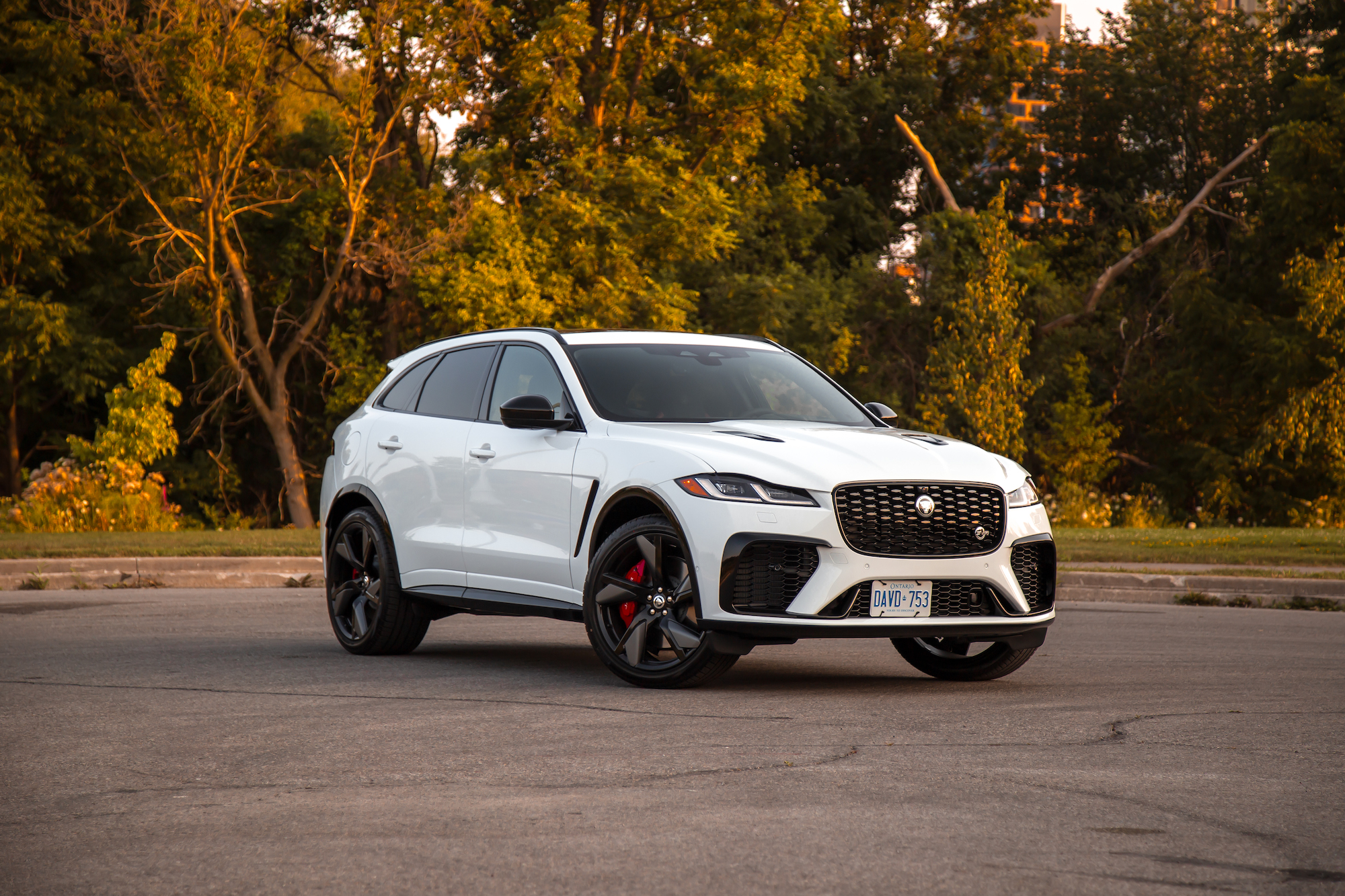
It’s that time of year when we bid farewell to vehicles that have been given the proverbial guillotine, and there are more sacrifices than you would expect now, with the significant push towards sustainable mobility. Jaguar is one of the remaining few automakers with a combustion-only lineup, currently offering just the F-Pace and F-Type, both of which ironically feature thirsty supercharged V8 engines and maniacal exhaust notes to match. But that’s where the chapter closes for the 2025 Jaguar F-Pace SVR, the end of the line for the feline SUV.

But what a way to tip your hat and nod a goodbye to combustion propulsion, because this lionheart of an engine is a howling and crackling supercharged V8 that’s tuned to produce an eye-watering 542 horsepower and 516 lb-ft of torque. It’s the same motor that powers the Jaguar F-Type R, Land Rover Defender V8, and the last-generation Range Rover Sport SVR.

Its wicked exhaust note sends goosebumps down our spines. Press the dedicated exhaust button and you can actually hear the mechanical valves open and come alive with eardrum-rupturing vocals that will awaken the dead. Granted, the SVR no longer fires up on ignition with obnoxious pops and crackles, and it’s more subdued than the outgoing SVR models, likely due to noise restrictions in other markets. However, the sound is undeniably unique and unmistakably an eight-cylinder.

The instant power delivery from the supercharged engine is addictive and the SVR will launch from 0-100 km/h in a scant 4.0 seconds. Everything you drive after (aside from electric vehicles) will feel slow and unresponsive. Paired with snappy shifts from the 8-speed gearbox, this SVR makes for a genuine alternative to the greatest from BMW and Mercedes. But it’s the brakes that impressed us the most. Strong with linear pedal travel, it takes only a slight prod of the pedal to elicit a potent stopping reaction. It feels a bit like a McLaren’s brake pedal and that’s as good of a compliment as it gets.

The chassis is stiff and the steering is light but chock-full of feel. Unsurprisingly, the same tradeoffs remain with a wooden ride that becomes compromised when negotiating deep potholes or heavy undulations. The SVR makes for a competent daily driver but don’t expect the same level of comfort as the regular F-Pace. The expected thirst from a V8 engine is also readily apparent – we yielded 15.6 L/100km with an equal mix of city and highway driving.

Call us stuck in the past but we think the F-Pace has grown more attractive over time. The silhouette has been manicured nicely and it stands out gracefully in a sea of X3s, GLCs, and Q5s. The SVR trim isn’t a dead giveaway, but you might be able to spot the subtle SVR badging on the trunk lid and wheel rims, the flared side air intakes, and the aggressive quad exhausts poking out the rear. Our vehicle arrived with just 100 km on the odometer, so the chrome exhaust tips were still squeaky clean and free from the muck and black soot that graces a well-used SVR.

The cabin has also become a warm and inviting place to spend time in. The steering wheel features an attractive design that debuted with the i-Pace, and we enjoy flicking the metal paddle shifters, as well as the convenience of the heated steering wheel button located on the right spoke. The steering wheel controls don’t click with the same positive feedback as their Land Rover counterparts and they aren’t very pleasant to interact with, especially since the black plastics are heavily prone to fingerprint smears and marks.

Still, the interior exudes English charm with enough suede and leather to warrant its six-figure price tag. Although the infotainment unit is ripped straight from the new Range Rover, it functions well and is lag-free. The deeply sculpted performance seats don’t just look great, but are also comfy and snug. Of note, there is no headrest adjustment.

Where exactly does the F-Pace SVR fit into the bigger picture, as performance SUVs are a fiercely competitive market with rivals emerging from all corners? The BMW X3 M Competition is a clear alternative. It drives better, handles more like a sports sedan thanks to its excellent driving position and agile front end, and is quicker to 100 km/h thanks to a high-revving inline-six engine. But its ride is almost unbearable at low speeds and heavily compromised by its weight, and the cabin isn’t quite as spacious. It’s about $3,000 cheaper than the SVR, though.
The Porsche Macan GTS is another direct rival, similarly priced but smaller in every dimension. The Macan has more precise steering and its ride is softer and more tolerable for longer distances, but somehow feels heavier around town. It lacks the acoustic thrills of the Jaguar V8. However, and although they’re about the same age, the Jaguar has aged better visually, both inside and out.
Like the Jaguar, the Maserati Grecale is a left-field choice for consumers who want something unique and outside the Teutonic status quo. The phenomenal Trofeo model is in a different price bracket altogether, so the comparable GT and Modena trims, with their four-cylinder engines, unfortunately, don’t quite cut the cake, despite offering crisp steering, a well-composed ride, and an interior oozing with Italian charm and character.
The Alfa Romeo Stelvio Quadrifolgio is another outlier. Strong in emotion, less so in actual sales. We think the Alfa drives better than the SVR, with better steering and a more compliant suspension, always feeling light on its feet and raring to go. We love how the V6 revs to the moon and emits a raspy beehive tune, almost like a mini-Ferrari. It’s similarly priced, and although its infotainment unit, user interfaces, and ergonomics lag behind those of the Jaguar, its driving position is superior.
We have yet to drive the new Mercedes-AMG GLC 63 with its trick four-cylinder engine but the outgoing model with the twin-turbocharged V8 would be a hard alternative to pass. If you can find a used one for considerably less than a new SVR, we would choose the AMG. That thundering V8 is nearly as soulful as the SVR but it’s more robust, the AMG is quicker, and the cabin quality is superior as well. One could also consider the Audi SQ5 or Range Rover Velar in this comparison, but we think they are too soft, underdamped, and catered towards comfort and luxury amenities to be adequately compared to the performance-focused SVR.

Despite its overwhelming amount of competition, the Jaguar F-Pace SVR remains an easy recommendation for buyers seeking a performance thrill from a functional and spacious five-seater SUV. Its supercharged V8 is the last of a dying breed, and when combined with the F-Pace’s excellent steering and rigid chassis, it makes us confident exploring its grip limits. The stiff ride, aging platform, and lack of hybrid or electric features may deter some buyers, but it continues to be one of the most charming, thrilling, and engaging sport SUVs on sale today.
Specifications:
Model: 2025 Jaguar F-Pace SVR
Paint Type: Fuji White
Base Price: $104,200
Price as Tested: $109,515
Curb weight (kg): 2,057
Engine: 5.0-litre supercharged V8
Horsepower: 542 hp
Torque: 516 lb-ft
Transmission: 8-speed automatic
Engine & Drive Configuration: Front engine, AWD
Observed Fuel Consumption (L/100km): 15.6
Tires: Pirelli Scorpion Zero; 22-inch


Leave a Reply