
As automakers race to electrify their lineups to meet global emission demands, BMW has quietly released some of the most innovative and impressive electric sedans we’ve driven. The thrilling i4 M50 was unexpected, as was the iX M60 with its prodigious speed and grand interior. The i7 M70 hit the nail on the head with absolute access to speed and luxury without the side effects of track-intended use that a full M badge would require, and the i5 M60 gave us a well-composed family sedan with enough range, power, and luxury to impress all and outrun most.

But enough about the letter M. It’s time we looked at the base model of the i5 range, the xDrive40, which is no slouch either thanks to four driven wheels and an 84.3 kWh battery that produces 389 horsepower and 435 lb-ft of torque. That’s enough to sprint from 0-100 km/h in 5.4 seconds with a range of 428 kilometres on tap. After a week of driving it, we believe the i5 xDrive40 is more refined, more engaging to drive, and a better product than the Mercedes-Benz EQE 500 and Tesla Model S.

That’s because it’s the most non-EV-like EV we have driven, and should be what future EVs strive to achieve. Dynamically, the i5 doesn’t operate like a light switch, shifting between on and off power like other EVs. There’s so much bandwidth to play with in the void, allowing us to fully explore its powerband in both low- and high-speed situations. This has us excited about what the new M5 has in store with its plug-in hybrid setup.

The i5 takes all the flattering attributes of the i7 and shrink-wraps it into a smaller package. The result is a sublime, comfortable, refined sedan that enjoys the gentle waft around town and the speedy scoot around a winding road. Every point of driver interaction is specifically engineered to feel engaging and polished. While the steering is unsurprisingly lacking in feel like in the i5 M60, its rotation is like whisking melted butter. The pedals are linear, like non-regenerative brakes, and the power delivery is steady, predictable, and won’t catch you by surprise. Frankly, it’s everything the EQE strived to be but couldn’t pull off successfully.

What also shines through is the ride quality. With a rear-axle air suspension, the i5 is stable at high speeds and flows over poor surfaces with confidence. The dampers do not neutralize small suspension movements as ably as the i7 but the i5 still houses a thicker layer of daily usability and everyday comfort than the Taycan.

And like the i7, the i5 pipes artificial electric noises into the cabin and changes depending on the selected driving mode. By default, the sounds are quiet and subdued but ramp up into deep, heart-wrenching tones in Sport Mode. If they sound familiar, like you’ve busted out the OST for Interstellar, Dunkirk, or Batman, that’s because Hans Zimmer composed these tones for BMW. And oddly enough, driving a non-EV after this i5 feels agricultural, unrefined, and unbecoming – weird how quickly the world and our perceptions can evolve.

What’s not so great is the range. Despite BMW’s claim of 428 km, we only achieved 360 km in an average of 15 degrees Celsius weather, and the cabin temperature was set to 22. That’s still usable whether you have access to home charging or not, but it’s a fact that Toronto is lagging significantly in public charging infrastructure.

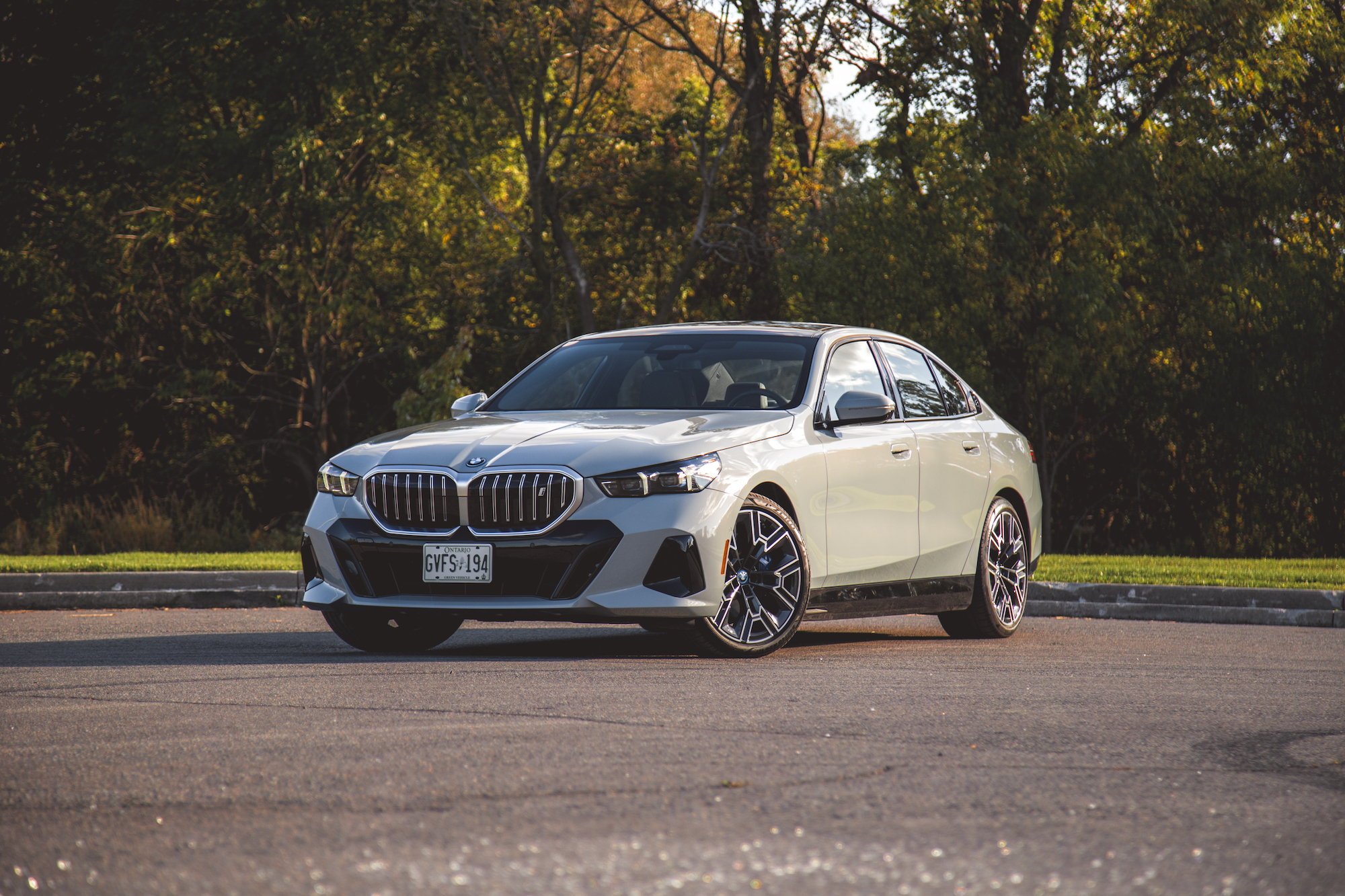
The i5 flourishes with one of the cleanest and most elegant designs in the current BMW portfolio, adorning a muscular shape with shoulders that are broader and more toned than a 3 Series. It wears slimmer and more attractive kidney grills than the controversial pair in the i7, and this one also illuminates for an additional $500 and we’ve come to enjoy its distinctive light signature at night. Draped in Brooklyn Grey, a sort of blue-ish gray, it’s an effervescent sedan commanding a great deal of road presence along with its flush door handles and ‘5’ badge lettered onto the C-pillar.

The interior is a significant step up in quality and amenities compared to the i4. The i5 is considerably more upscale in all driver touchpoints, from the leather-wrapped steering wheel to the glass switches and rotary dial. There are still many plastic areas and we have a few qualms with the weirdly cheap-feeling gear toggle and the low-rent window switches. Further, the memory seat controls on the door panel fall into the same ergonomically messy category as their Mercedes counterparts. There are no grooves of any kind and the panel is mounted vertically and angled away, so from the driver’s seat, you never really know what button you’re pressing. Most of the time, it’s a guessing game to which memory seat number you are engaging.

Still, we love trickle-down economics and the i5 interior is essentially an i7 at 75% zoom, and there’s subsequently enough pizzazz here to feel excited yet comfortable. We enjoy this display setup, with two widescreens attached under a single piece of glass. While not as visually dazzling as the Hyperscreen in the Mercedes EQE and EQS, the BMW’s is much more functional and sports a lower learning curve. It’s operated via both a touchscreen and a rotary dial with actual buttons, making it easy to navigate the menus even while focusing on the road. Having real toggles and dials on the steering wheel makes it more accessible than those fussy haptic touch sensors littered in every electric Mercedes and Volkswagen. This is user functionality done properly.

Speaking of which, the steering wheel is a porky size and requires hands the size of Popeye’s to fully wrap around the rim, but aesthetically it’s much better looking than the rather ordinary example in the i4 and the wonky two-spoke wheel in the iX. The purposeful holes on the bottom spoke are a nice finishing touch, as is the solo paddle shifter on the left-hand side, borrowed from the defunct i8 supercar and aptly labelled ‘Boost’. Toggling this activates Boost mode, unlocking maximum power output from the batteries for ten seconds to aid in overtaking or launch control maneuvers.

The way the fan vents are concealed right under the nose of the screen is clever but the directional fan toggles at the bottom of the center stack look out of place. The i5 sports a spacious and atmospheric cabin but it’s a bit tight on rear-seat legroom when sitting behind my six-foot self. The amount of headroom is generous throughout, and the large entry portals facilitate easy ingress and egress. It’s a shame the sunroof doesn’t open, and trunk space is annoyingly shallow with the batteries taking up a sizable chunk of real estate.

Driven in isolation, the i5 xDrive40 is an objectively impressive EV sedan. Driven next to its competition, it stands out even more, showcasing its superior powertrain tuning, chassis fluency, styling attributes, and star quality. Skip the EQE, Taycan, and Model S. This is the complete package and one of the best EVs we have driven all year.
Specifications:
Model: 2025 BMW i5 xDrive40
Paint Type: Brooklyn Grey Metallic
Base Price: $83,700
Price as Tested: $97,750
Wheelbase(mm): 2,995
Length/Width/Height (mm): 5,060 / 1,900 / 1,505
Powertrain: 84.3 kWh high-voltage battery, two electric motors
Horsepower: 389 hp
Torque: 435 lb-ft
Transmission: Single-speed automatic
Engine & Drive Configuration: Front and rear electric motors, AWD
Claimed Range: 428 km
Observed Range: 360 km
Tires: Pirelli P Zero 20-inch; 275/35R20 rear; 245/40R20 front



Leave a Reply