
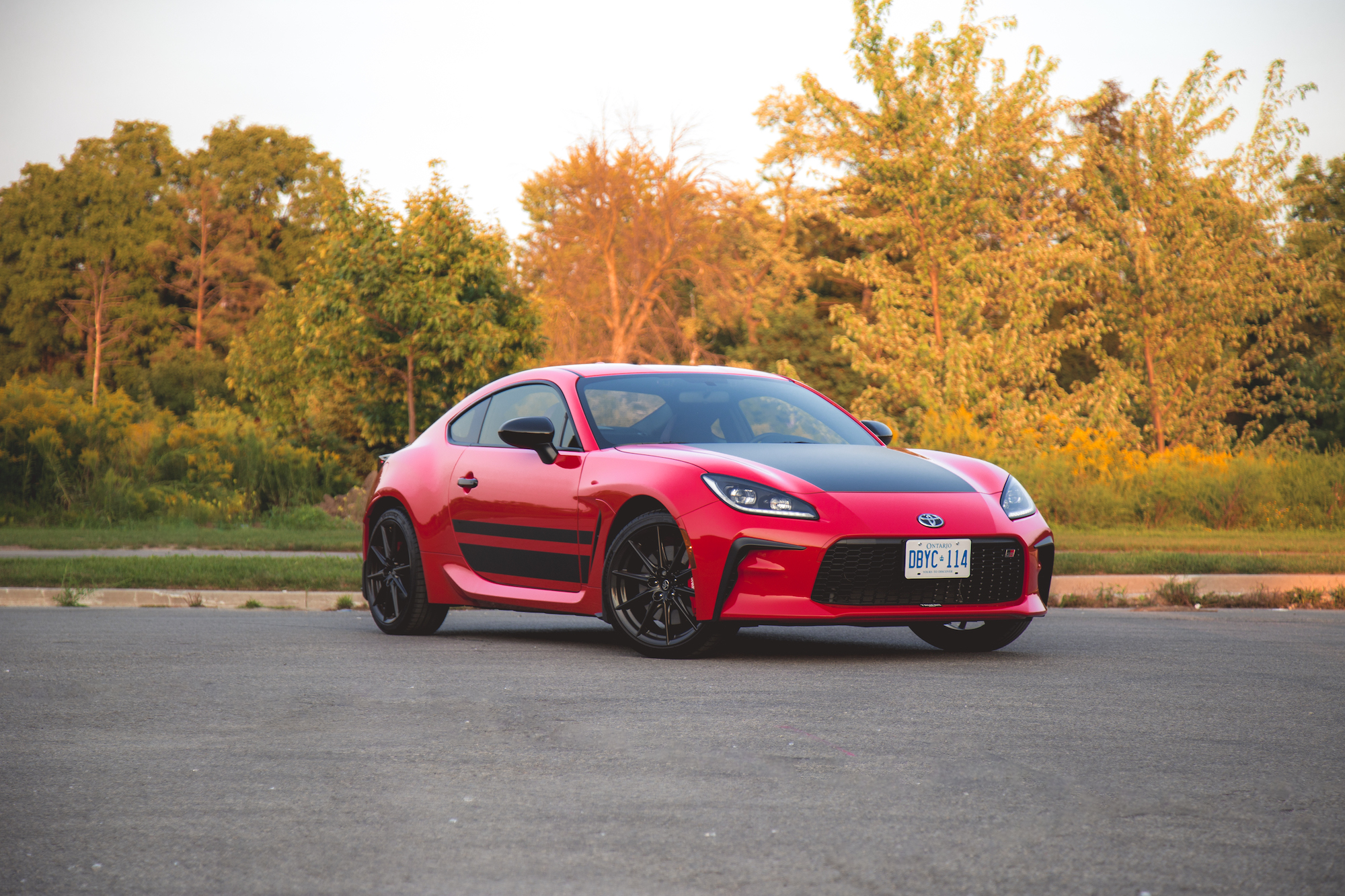
If the thought of a white tofu car touge racing along the Japanese mountainside doesn’t get your heart pumping, this car might not be for you. This is the Toyota GR86 Trueno Edition, and it celebrates 40 years since the launch of the original AE86 in the 1980s.

While we Canadians might want to believe that Trueno stands for True North, it’s actually based on the original Toyota AE86 Sprinter Trueno that was widely popularized by the Initial D anime. This special edition comes with Trueno badging on the front bumper, rear trunk lid, and shift knob. There are also 18-inch forged-alloy wheels finished in black metallic, a two-tone black hood and side panel graphics, and two choices of paint: Halo and Track bRed. Standard on the Trueno Edition are ZF Sachs dampers and Brembo brakes. Nevertheless, we still don’t recommend gutter runs or one-handed techniques.

Now, nostalgia is a fickle thing. If done properly, it can inspire and make one wonder. Done poorly, and it taints the brand and the image that took decades to mature. We’re a bit lukewarm on this one, maybe because we think the white paint suits it better rather than the red we’re driving. Just look at Toyota’s official press images above and below, where they used photo editing to mimic the Initial D aesthetic. Now that’s cool.

But other than the badges and graphics, there’s not much else of substance to give us a greater sense of want and nostalgia. And about that new shifter, I knew it felt familiar the moment I rested my palm on it – it’s the same shifter as the GR Corolla in the Morizo Edition. A thick obelisk of a knob that feels good under grasp and is top-heavy, but not slim and precise like the Civic Type R’s silver bullet. We wish they had more unique performance additions – maybe a unique tire tread or pop-up headlights (one can dream).

At least the underlying base is one of the best-performing sports cars available for purchase in 2024. The GR86 utilizes a naturally aspirated 2.4-litre flat-four borrowed from Subaru that produces 228 hp and 184 lb-ft. That’s a significant 23 hp and 28 lb-ft more than the outgoing 2.0-litre engine. It might not seem like much but the extra torque and the fact that it comes on earlier at 3,700 rpm make all the difference in the way the GR86 now behaves. It no longer feels like you have to climb a mountain to get any kind of forward propulsion, the mid-range is now full of gusto, and the second-to-third-gear rip is one of the most satisfying.

This is not to say that the GR86 rewards laziness. You still want to keep the needle hovering above 3,000 rpm for accessible thrust, and there’s little value in exploring past 7,000 rpm where the GR86 begins gasping for breath. It’s a more characterful and robust engine than the Mazda MX-5’s, though not as polished, refined, or as rev-happy as it wanders around its powerband. Hammer it hard though, and the GR86 will reach 0-100 km/h in a swift 6.3 seconds, nearly a full second quicker than before (7.2 s). The automatic-equipped models will do that run in 6.8 seconds, 1.4 seconds less than before.

Even offering the option for three pedals is a rarity in today’s world – a necessity for some, a delicacy for others, and an unknown concept for the majority. Toyota’s GR department has been keeping this method of rowing gears alive longer than most, yet they’ve ensured that the GR86 isn’t a difficult vehicle to pilot, adding to its appeal for beginners. Shifter travel is precise, short, and free from the notchiness that plagues some gates. The clutch bite point is both consistent and forgiving. The gearing isn’t particularly tall and rewards precise shifting at the correct RPMs and with quick inputs. The pedals are perfectly positioned for heel and toeing and the footwell doesn’t feel as cramped or as narrow as the MX-5. The whole cabin feels spacious for my slender six-foot figure, and the driving position is excellent: low down yet with excellent outward visibility. We do wish the steering wheel would telescope more toward the driver.
Of note, we have yet to test the automatic-equipped GR86, which commands a $2,400 premium and a 16 kg weight penalty, but it does come standard with all of Toyota’s advanced safety features like pre-collision braking, dynamic radar cruise control, lane departure warning, sway warning, and lead vehicle start alert. These are not available in the manual gearbox models.

The GR86 does not produce the most flattering of exhaust noises, increasing in volume rather than character as the revs rise. Its vocals are gravelly like there’s sand and rocks choked up the larynx. We know many flat-four engines with more captivating voices but alas, we don’t expect many of these GR86s to keep their standard exhausts anyway. And Toyota does pipe in some noise through the cabin speakers, but we hardly noticed.

The steering breathes life into the drive – it’s rare that we hop into a car and instantly feel so connected to the machine. Turning the wheel gives you a sensation of both grip and speed as vibrations flow through your fingertips. The steering is light without being over-boosted, quick without being too twitchy, and is one of the best electric steering setups at this price point. We wouldn’t mind a slightly quicker ratio, as it requires quite a bit of rotation at low speeds but otherwise, its crisp feedback and fidelity are perfect for a coupe of this size, making it easy to find harmony with the road.

The GR86 rides better than before, thanks to a 50% increase in torsional rigidity and notable weight savings from the use of aluminum for its roof, hood, and fenders. In addition, Toyota modified the chassis and suspension to take full advantage of the sticky Michelin Pilot Sport 4 rubber. You can feel the weight transfer through your seat and the rear slowly slipping away under mid-corner throttle application. It gives you the confidence to push the GR86 to the edge of adhesion, and let the electronics guide you around like a hero.
Handling-wise, it’s not a particularly neutral feeling, and its cornering antics are significantly less forgiving when you turn off the stability and traction control, but we had more fun in the new GR86 than any other budget sports car in the class. That says something. The Volkswagen Golf GTI offers a similarly engaging experience and is nicely complemented by its torquey turbo-four engine, but its frustrating infotainment system and mundane front-wheel-drive behaviour can be a hard sell. The same goes for the angry and belligerent Hyundai Veloster N, which we just couldn’t gel with and grow to love on a back road. We have yet to drive the new Honda Civic Si.

Cruising at discreet speeds reveals a surprising degree of road and tire noise. The GR86 rides rougher than a Golf GTI but is more sorted than the Veloster N. It adores hugging the road and exploring the bottom of every pothole, but it’s tolerable and most of the time, we were so engaged in the road flowing below us that we ultimately preferred the GR86’s compromise of comfort for excellent road-holding ability.

And have we mentioned how good it looks? The overall design is much softer than before, an exercise in restraint, because not every sports car needs a massive rear wing and comically flared fenders like the Honda Civic Type R. The sculpted rear end is accentuated by that ducktail spoiler and the new side air intakes give it extra visual depth compared to the outgoing 86 that did without one.

While not the focus of Toyota’s R&D department, the interior no longer feels like an afterthought. The digital driver’s gauges are high in definition, and we prefer its info layout better than the GR Supra’s, surprisingly. A somewhat basic 8-inch touchscreen graces the center console and it’s compatible with Apple CarPlay and Android Auto for those that prefer a more familiar interface. Speaking of familiar elements, Toyota has also borrowed the keyfob and gear shifter from Subaru.

Ergonomics come into play nicely with perfectly positioned cupholders and a foldable cover for the center armrest that doesn’t get in the way of the shifter or handbrake. Some materials used are questionable – the plastic toggles for the HVAC feel as thin and fragile as a sheet of paper, but there’s some mid-grade leather and soft suede to aesthetically enhance it all. Just don’t go expecting the Audi-grade quality that you will find in the Golf.

The seats are supportive but feel like they need more padding, although they complement the thin-rimmed steering wheel, which is replete with buttons to control the infotainment. A part of us wished they offered a simpler, bare-bones steering wheel without any buttons, just like the outgoing models.

The GR86 Trueno Edition is an exercise in using nostalgia to sell more special edition models. It works to an extent, but we wish Toyota had doubled down and given us a little more for the money. At least the underlying GR86 is a great deal already, offering a raw driving experience that engages and involves the driver. Just choose the white paint and skip the red. Takumi would probably approve.
Specifications:
Model: 2024 Toyota GR86 SE 6MT TRUENO Edition
Paint Type: Track bRed
Base Price: $39,150
Price as Tested: $39,150
Wheelbase(mm): 2,575
Length/Width/Height (mm): 4,265 / 1,775 / 1,310
Curb weight (kg): 1,285
Engine: 2.4-litre flat-four
Horsepower: 228 hp @ 7,000 rpm
Torque: 184 lb-ft @ 3,700 rpm
Transmission: 6-speed manual
Engine & Drive Configuration: Front engine, RWD
Observed Fuel Consumption (L/100km): 11.2
Tires: 215/40R18; Michelin Pilot Sport 4


Leave a Reply