
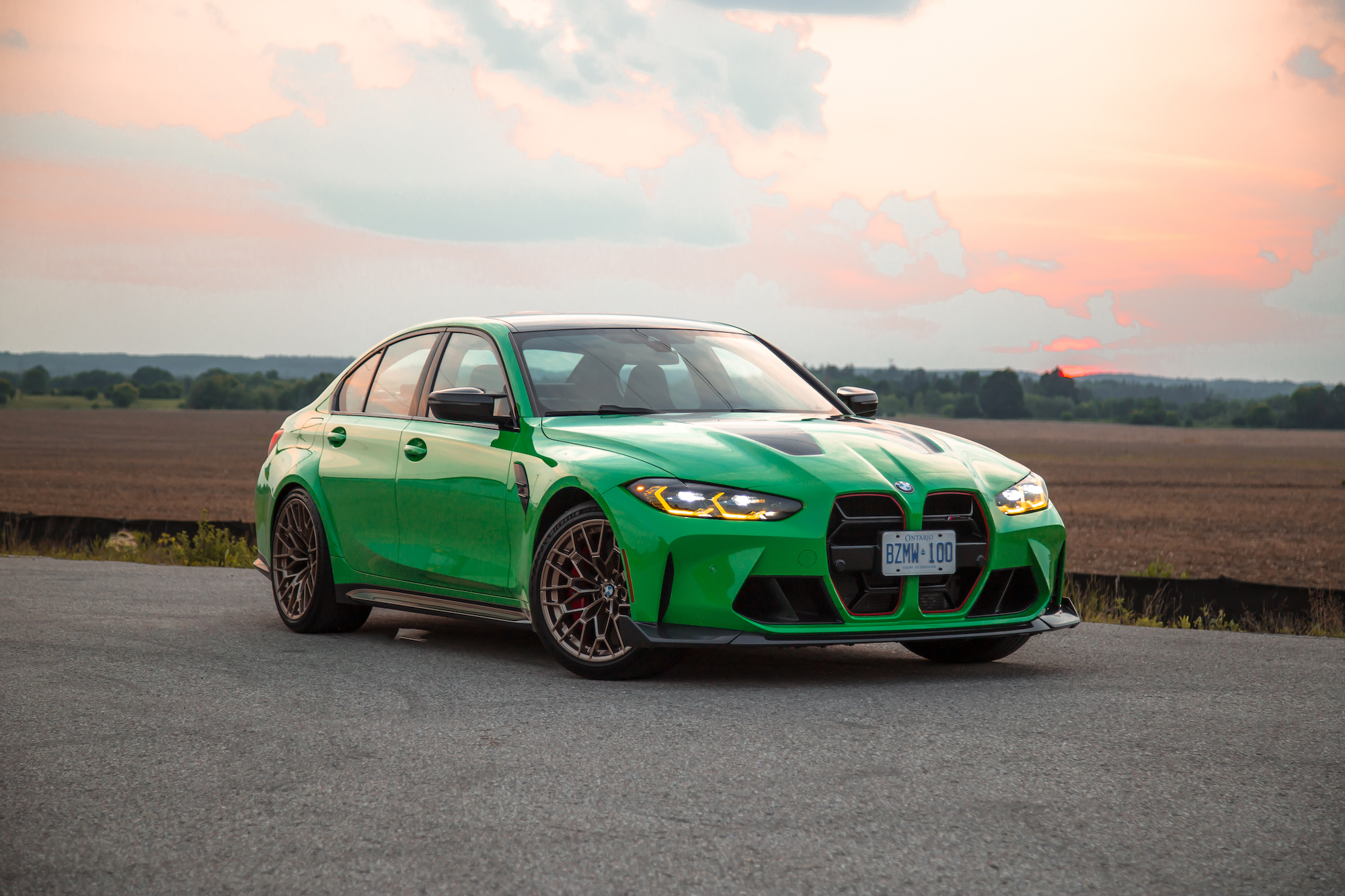
CS stands for Competition Sport, and it’s a badge that BMW bestows onto their most hardcore, track-ready, street-legal cars. In the case of the new 2024 BMW M3 CS, it means a retuned engine with more boost pressure and 40 more horsepower, cooling tech borrowed from their GT3 race car, added engine mounts for stiffness, optional carbon ceramic brakes, and sticky Michelin Pilot Cup 2 tires that assist in launching it from 0-100 km/h in 3.4 seconds, faster than the M4 CSL.

The CS brief was for scintillating performance that can be used daily, without the compromises in usability that hampered the M4 CSL. That means this M3 CS keeps its all-wheel drive system for maximum traction and like the M5, can decouple the front axle for a pure RWD experience. The 8-speed automatic also had to be beefed up to handle the 543 horsepower and 479 lb-ft of torque, and no manual gearbox could handle that even if it does offer superior driver engagement. Porsche RS models deal the same auto-only card.

BMW also pared away as much weight as possible with the CS, utilizing lightweight carbon-fibre reinforced plastic for the roof, front hood, seats, center console, and exterior aero kit. Along with a titanium rear silencer, these amount to 34 kg of weight savings compared to an M3 Competition xDrive. Relatively, it’s still not a lightweight special by any means but they do amount to a palpable difference on the road.

There aren’t any other performance sedans on the current market that are as raw and track-focused as this one. The four-cylinder Mercedes-AMG C 63 and aging Audi RS 5 Performance don’t even come close to the unabridged performance of the CS. Perhaps the Cadillac CT5-V Blackwing is more comparable, and you could probably find an Alfa Romeo Giulia GTA or a Jaguar XE Project SV on the used market somewhere on the far side of this continent, which both adhere to the same guidelines.

Firing up the inline-six and taking your first stab at the throttle is an experience on its own. The CS emits your typical BMW racket with metal-on-metal whines, but there’s enough intake noise at 3,500 rpm to wake the dead. It is not a soulful, charming, or even nice noise to listen to, but the raw octaves suit the M3 well, in the same way that heavy metal suits a playthrough of DOOM – it just wouldn’t hit the same with jazz or classical.

The resulting acceleration is wicked. For an 8-speed automatic to shift this fast and smoothly is a masterstroke of engineering. Shifts are dispatched more quickly than many dual-clutches on the market, and it is robust enough to handle all that torque. That said, the powertrain despises slow driving in its sportiest driving modes, and punishes anything less than half-throttle inputs with jerky motions and awkward lurches at speed. It’s a car that wants to be driven hard.

You notice that the first time you hop inside the CS. It’s like hopping into an M4 GT3 race car and settling in for a Le Mans qualifying lap – there are so many settings, parameters, and drive modes to adjust that it can feel overwhelming without a race engineer spewing commands over the radio. However, once you’ve experimented and found your preferred settings, you can save them to one of the two M buttons on the steering wheel for quick access.

We highly recommend selecting MDM traction mode, our personal favourite for a bit of fun. The systems are tuned to allow power oversteer and grin-inducing slides, while reining you back should you overcook your inputs. Think of it like a guardian angel that enjoys letting loose every now and again. This allows the M3 CS’s lively behaviour to truly shine and decouple from its traction-control chains. The way the nose plows into corners will make every other sports sedan cower with envy. It progresses into a rear-controlled slide with a slight flick of the throttle and opposite lock, but it’s not as easy as you might think.

Breaking the ceiling of mechanical grip with these sticky Michelin Cup 2 tires takes purposeful weight transfer off the rear axle and generous bouts of inertia and momentum to boot. But once you do coax the rear to play, it’s so controllable and manageable that it reminds us of the ESC tuning in the Lamborghini Huracan and Urus: spirited yet not overly conservative. It knows when not to cut you short and ruin a moment that’s sure to put a grin on your face. Of course, you could fully deactivate AWD, but there are also ten adjustable levels of traction control mode, similar to the AMG GT R dial, for those who are still learning and not yet completely at one with the CS.

While we have only waxed praise for the CS’s sporty prowess, we were surprised to discover an amazingly docile demeanor when exploring its dialled-back driving modes and with the exhaust valves closed. Stab the go-fast pedal and the exhaust is quiet and subdued. It doesn’t bark or howl even with the decreased cabin insulation. You can still hear stones and pebbles bouncing off the underside but the powertrain glides through its eight gears gently and behind closed curtains. The suspension is harsh compared to the standard M3 but it’s fair and expected. Firmer than a Honda Civic FL5 Type R, but not as compromised as a Porsche 992 GT3 RS on a smooth road. The carbon ceramic brakes are also full of bite but they don’t squeal when cold so you don’t look like a tool pulling up at every intersection.

Well, you actually might in this paint colour. Signal Green is an acquired taste but you can also select Brooklyn Grey Metallic, Sapphire Black Metallic, or Frozen Solid White instead. Still, the gold wheels are a sweet addition, as is the low-riding titanium exhaust that you can actually see hanging down behind the rear bumper. Other CS upgrades include a subtle lip spoiler, an M3 badge on the side fender, and a black hood stripe.

It’s eye-opening just how much better the controversial M3 kidney grill looks now with its GT3-style inlets. There is more negative space and fewer horizontal slats, and the sizable front splitter gives the CS the chiselled jawline of a certain Californian governor. It would look even better if the number plate were mounted on the side or gone altogether, and we would honestly be tempted to spring for the CS upgrade for the looks alone. To sweeten the deal, the CS receives yellow headlights just like on its race cars, but they only activate with the low- or high-beams, or when the vehicle is unlocked.

To keep with the sporty theme, the CS’s interior is fully lathered in carbon fibre, alcantara, and leather. Gone is the center armrest cover in the name of weight savings, and in its place is a coverless cubby and a CS-badged leather wrist-rest, which is useful when fiddling with the rotary dial. Speaking of which, this is the last-generation BMW rotary dial, which actually feels better to use. There is more tactile feedback in its clicks and rotation feedback, and we find it more responsive than the new dials in the iX and i4. The newer units require more force to activate and have a thinner margin of error in dial movement. Each is still a quality item, though, and fully maximizes the user experience with the touchscreen interface.

Clearly, BMW could have gone even further with weight savings if it were a major priority, but it seems they always wanted to retain a sense of usability and practicality for their drivers commuting to and from the track. The wireless phone charger and heated seats are the obvious additions, but the lack of a center cubby or 360-degree camera feels like they’ve been awkwardly left off the table. Why not eliminate the rear seats, install a roll bar with a fire extinguisher, and replace the door handles with fabric door pulls? Additionally, consider using thinner, lighter window glass panels. Seems a bit wishy washy on what they chose to exclude and include.

Still, BMW is the only manufacturer we’ve seen that matches the exterior paint colour to the in-screen car displays. In this case, it’s spot on with the Signal Green paint and even down to the gold wheels. Turn the wheels or flick the signal stalk, and the live display will show exactly what it looks like from the outside as well. Even Range Rover, Audi, or Mercedes don’t do this, but we think the few extra lines of code go a long way in making a vehicle feel more special and individualized.

But it’s the carbon bucket seats that are the showstopper. While intimidating in appearance, they are very supportive once slotted inside. But hopping in is as difficult as any bucket seat. Porsche’s are no less tricky, as the hard and fixed side thigh bolsters will needlessly slot themselves into you like a suppository if your ingress motions are not meticulously planned out beforehand.

The seatback only adjusts fore and aft, and there is no headrest adjustment either. Not that you need them – the seat is so snug, racy, and comfortable, and it can be lowered very far to the ground so you feel like you’re almost touching the tarmac below. There are holes for multi-point seatbelts, and they are lighter in weight than the standard sport seats, but we don’t think by much, as they still feature heated and memory functions, as well as electronic adjustment. Even the CS logo illuminates at night.

The BMW M3 CS is a hardcore sports sedan that hasn’t forgotten its road manners. A discernible and palpable upgrade over the M3 Competition, it reacts and drives like a race car the moment you fire up the inline-six reactor. Yet its AWD system and extraordinary mechanical grip mean it’s not as compromised as you might expect in inclement weather. The way the CS launches into unholy speeds and grinds to a stop just as quickly appears to undermine BMW’s stated figures – its performance feels more supercar territory. Although slightly compromised in road comfort and ingress ergonomics, the tradeoff is well worth it. The CS is the complete package.
Specifications:
Model: 2024 BMW M3 CS
Paint Type: Signal Green
Base Price: $148,000
Price as Tested: $162,900
Engine: 3.0-litre twin-turbocharged inline-six
Horsepower: 543 hp @ 7,200 rpm
Torque: 479 lb-ft @ 2,750 – 5,950 rpm
Transmission: 8-speed automatic
Engine & Drive Configuration: Front engine, AWD
Observed Fuel Consumption (L/100km): 17.5
Tires: Michelin Pilot Sport Cup 2



Leave a Reply