
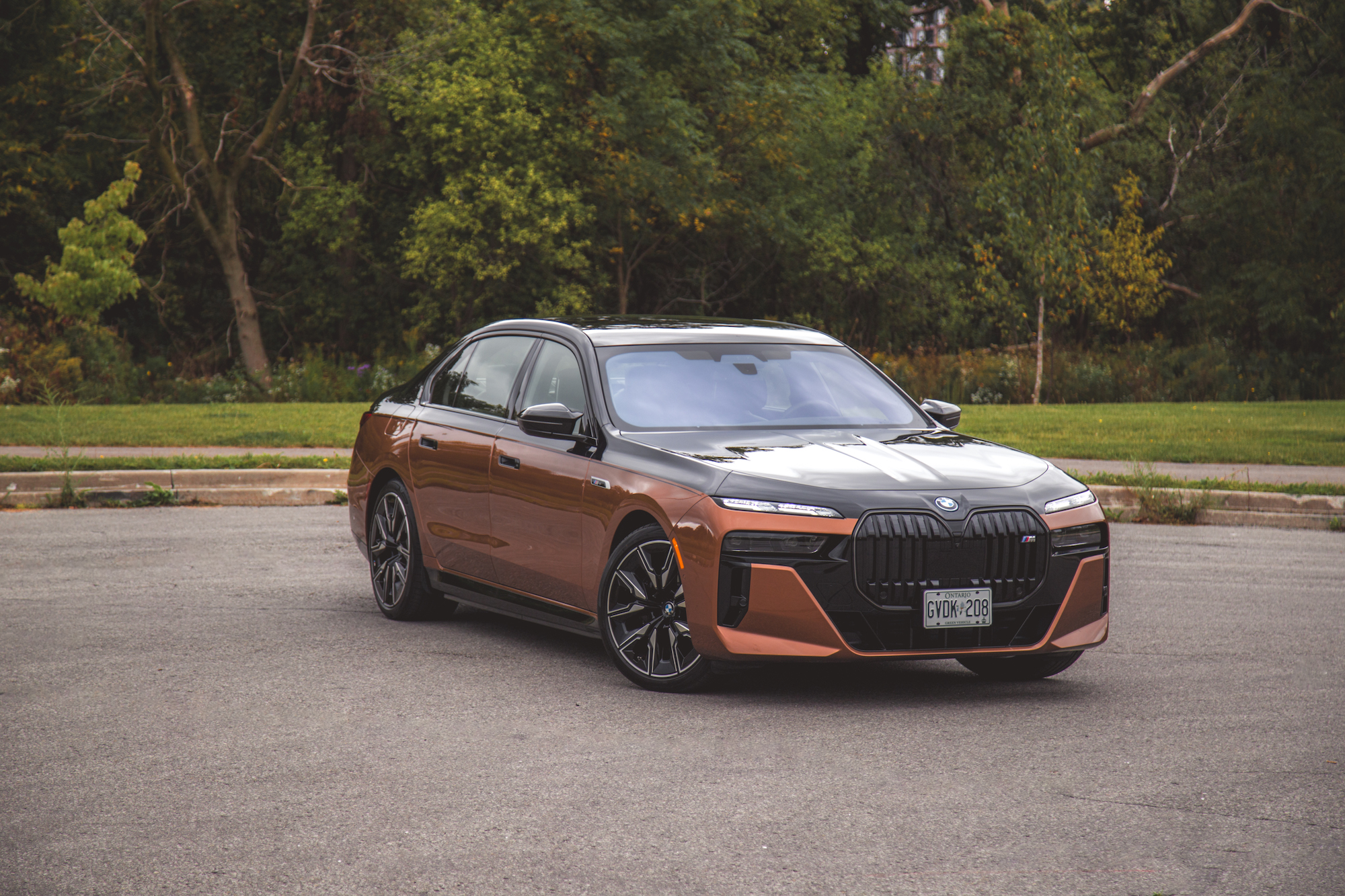
This is the apex predator of the 7 Series range, the i7 M70 xDrive. While the name doesn’t exactly roll off the tongue, it is the zero-emission replacement of the V12-powered M760Li, and is the most powerful 7 Series to date. Shy of calling it an M7, this two-tone paint scheme, 811 lb-ft of torque, and the ability to out-accelerate an M4 CSL puts it at the top of the BMW pedestal.

But why call it an M70 instead of an M7? Who is this flagship executive rocket for? Those who just want the biggest, baddest, and quickest 7 Series? Yes and no. The naming makes sense in some ways. BMW wanted absolute access to speed without the side effects of track-intended use that a full M badge would require. Things like a stiffened-up suspension that would help with turn-in sharpness but ruin the ride quality, larger tires that offer better grip but emit more noise, and reduced electric range due to favouring a higher battery state. Maybe lighter materials, a larger spoiler, and all manner of cosmetic items that may lighten this land yacht by a few kilograms and shave a thousandth of a second off a lap time, but offer substantially less in driver engagement. These are all M-badge prerequisites that, in our opinion, would detract from the joys of driving a 7 Series. Naming it an M70 remedies that and reduces expectations.
Because the i7 M70 excels at its intended brief: ultimate EV speed in a lofty, luxurious, and comfortable executive sedan with a cavernous interior and first-class amenities. It’s the brief that many aim for but end up compromising due to Nürburgring lap time requirements.

And the speed is no joking matter. We have to rewire our brains just to keep up with the pace. Activate Boost mode by flicking the left paddle shifter and the M70 launches off with prodigious haste. Think of a Boeing 777 on take-off: smooth and progressive, but it’s only when you glance out the window and spot the blur of trees and tarmac that you finally perceive your speed.

That’s all courtesy of two electric motors. Driving the front wheels is a 255-hp motor, which is the same unit as the one found in the i5 M60. The rear-mounted one is the big whale, delivering 483-hp on its own and is BMW’s most powerful motor to date. Total output is 650 hp and 749 lb-ft of torque, with 811 lb-ft on tap for short bursts. That’s 50 hp and 122 lb-ft more than the fire-breathing M760Li it replaces. Notably, BMW offers another M Performance model, the M760e, featuring a 571-hp PHEV powertrain but it’s not sold in North America.

Those figures are enough to launch the M70 from 0-100 km/h in 3.7 seconds, notably slower than the Mercedes-AMG EQS Sedan (3.4 s), Porsche Taycan Turbo (3.2 s), and the Audi RS e-tron GT (3.3 s). But once again, this isn’t a full M offering focused solely on outright speed. Other factors at play are more important.

Because while its rivalling EV sedans are objectively quicker, the M70 is more polished in every area. It handles like an absolute peach. The steering wheel acts like an extension of your arm. Movement isn’t artificial, it’s light and agile, gradual and fluent, and more importantly, predictable – everything the EQS AMG wanted to be but isn’t. The BMW is relaxing to drive and sucks out all the stress from a daily commute. It is more compliant on the roads than a Taycan and is also more comfortable. High-speed stability is superior, and roll is kept to a minimum too thanks to four-corner air springs, active roll stabilization, and 2.5-degree rear-axle steering that allows for nimble choreography in cramped parking spaces.

The interior is a feast for the senses, and we find the mix of crystal switchgear and the vast array of ambient lighting panels adds a touch of visual flair to a competitive segment. However, we yearn for more options and elements exclusive to the M70, because, from our perspective, this appears to be identical to the standard i7 and 750e. Even the steering wheel and digital displays are identical. No mention of an M70 anywhere.

We do have this optional and ridiculously cool cashmere and wool blend on the lower half of the seats and door panel, available in both light and dark grey tones. Whereas many automakers focus on premium leather or sustainable materials, it’s nice to see BMW experimenting with other fabrics. Don’t expect the soft and buttery textures of a Loro Piana sweater, though. This is more wool than cashmere in its feel. Less scratchy sweater, more fuzzy peach.

We wish they had doubled down on it and used the material more liberally around the cabin, like the Toyota Century and its wool upholstery. We don’t think it’s old-school at all – quite refreshing actually. And the blend is more comfortable than the standard leather seats too. There’s more give and vertical plush in the cushioning, allowing you to sink lower and enabling the bolsters to wrap around you more effectively. The material is less susceptible to exterior temperatures compared to leather. The downside is upkeep, an inherent hassle, so if you intend to throw dogs and messy infants in the back on a consistent basis, probably best to stick with leather.

Distinguishing an M70 from its stablemates is difficult. Other than the obvious M70 badging on the trunk lid, there are M badges above the front wheel arches and on the front grill, as well as a rear lip spoiler. But we still can’t help but wonder how much better the 7 Series would look if its designers focused less on the size of their grill and more on their design history. There was so much potential here – could you imagine a retro-style front grill and headlights like in BMW’s Neue Klasse concept? Add a boxy silhouette like the Toyota Century, and include a full cashmere interior – we think that would be enough to lure S-Class buyers away. And what better way to usher in the electric future than with a nod to the past?

We have to admit that the two-tone paint options are bold and appealing. They are pulled off well here with Sapphire Black and Liquid Copper, emphasizing the i7’s grand proportions and visually separating its torso. Of note, you can still get a two-tone paint scheme with the regular i7 but if you truly want to dive down the rabbit hole of customization, check out their extensive BMW Individual customizer here.

The i7 M70 is a competent and tantalizing executive sedan that doesn’t conform to societal standards, which dictate that every sports car manufacturer must offer a track-ready halo model. Rather than shaving tenths, the M70 shaves off discomfort, and the result is one of the best-driving BMWs to date. Though it won’t win any pageant contests, the M70 handles beautifully and progressively on any road and delivers the ride quality and interior amenities that you would expect from a nearly quarter-million-dollar automobile.
Specifications:
Model: 2024 BMW i7 M70 xDrive
Paint Type: Liquid Copper and Sapphire Black Two-Tone
Base Price: $185,000
Price as Tested: $225,400
Wheelbase(mm): 3,215
Length/Width/Height (mm): 5,391 / 1,950 / 1,544
Powertrain: 101.7kWh lithium-ion battery, two electric motors
Horsepower: 650 hp
Torque: 749 lb-ft of torque (811 lb-ft with overboost function)
Transmission: Single-speed transmission
Engine & Drive Configuration: Front and rear electric motors, AWD
Claimed Electric Range: 459 km
Observed Electric Range: 435 km
Tires: Bridgestone Turanza; 255/40R21



Leave a Reply