
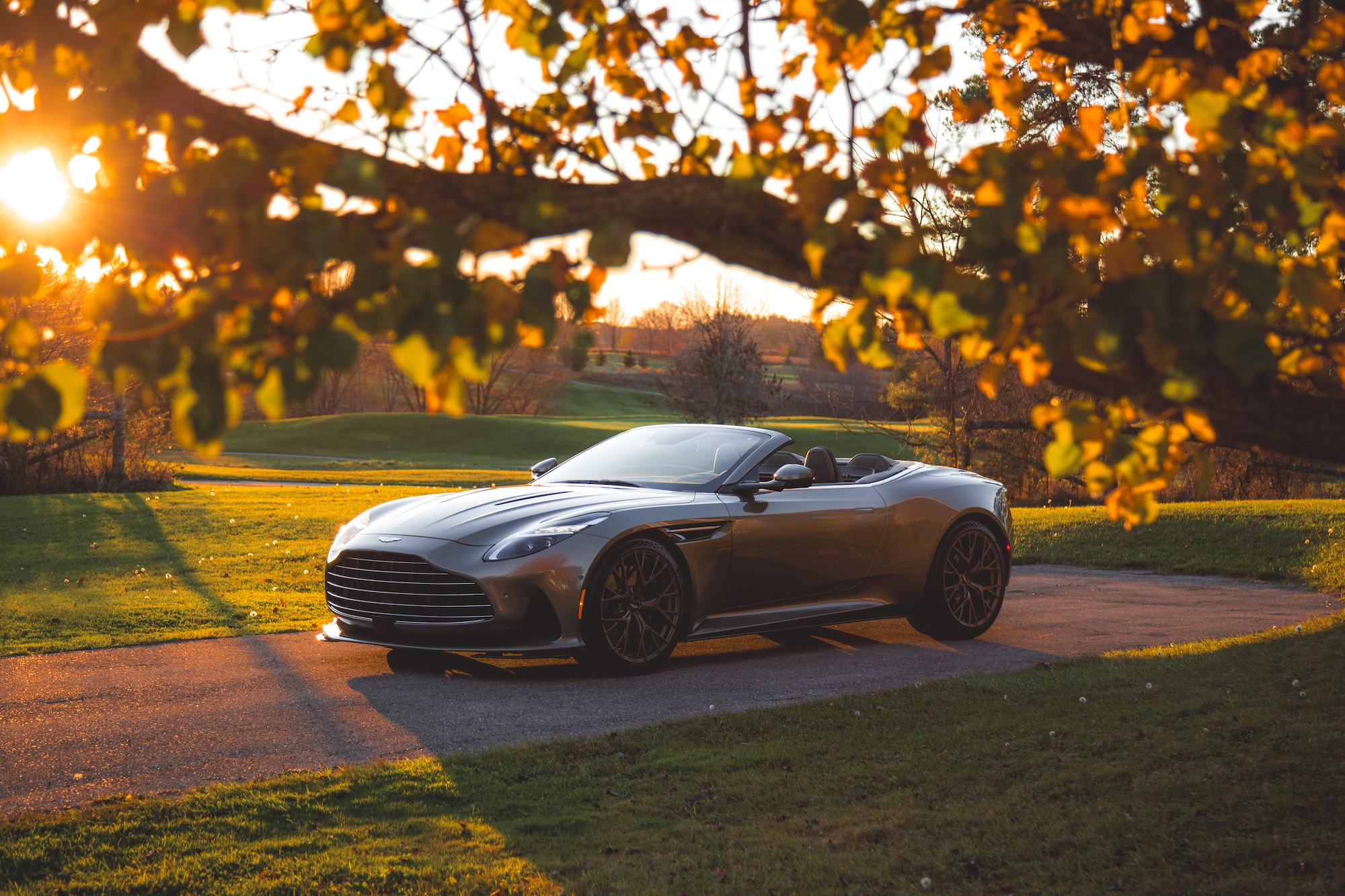
No Aston Martin review is spared of secret agent references but for the new DB12 Volante, we will show restraint because for what seems like the first time in the brand’s 110-year history, the vehicle itself is so accomplished that it doesn’t need camouflage paint and heat-seeking missiles to boost its beauty and magnetism. Less Queen and Country, and more Horsepower and Torque. Along with the recently announced Vanquish and Vantage, the DB12 represents a resurgence for the British brand, a vengeance to reclaim the title as the most successful grand tourer, and to show its German and Italian rivals that Stroll’s investment has paid off.

The previous crop of Aston Martins never struck the right chord with us. The outgoing DBS Superleggera had a sinister curb presence and a sleek silhouette, but it lacked the timeless look and imperiousness that made the DB5 and DB9 so memorable. The same criticism applies to the DB11, but the DB12 takes a new design direction and, almost overnight, has remedied those concerns. The widened front grill and its six horizontal strakes (five in the Vantage, seven in the Vanquish) have completely changed the look, giving the front end more geometric muscle and a delectable shape. The Volante looks even better, a sentiment we share with most 2+2 sports cars, such as the Porsche 911 Cabriolet and the Bentley Continental GT C.

You won’t find a DB12 badge anywhere on the sheetmetal until you open the swan doors and spot it on the door sill. Swan doors have been a staple of Aston Martin, with the doors swinging slightly upwards to avoid scraping curbs. The hinges will stop the door at any angle you leave it, too—a nicely engineered feat that comes off less gaudy and flashy than a McLaren or Lamborghini scissor door.

Titanium Grey looks tremendous as the sunlight fades and softens but there’s an entire platoon of colours and a comprehensive list of greens in the Aston Martin palette. One unique aspect of Aston’s online configurator, which we haven’t seen in others, including BMW’s extensive Individual customizer, is a short paragraph about the significance and history of each paint colour. Hover over 1959 Racing Green and it will tell you that it’s the same original shade that was on the Le Mans-winning DBR1 race car. Or try Podium Green, which is the same paint as the AMR24 Formula 1 car, as well as the F1 safety car and the F1 medical car. The configurator explains it all and more importantly, adds proverbial depth to each colour available.

The interior is a quantum leap forward. The previous crop of Aston Martin cabins was premium but cramped, messy, and relied too heavily on reliable yet outdated Mercedes technology. No more. Aston has fashionably invested in the proper gear and it’s now a digital circus with a myriad of embroidered, embossed, and electronically animated badges and logos. The switchgear feels expensive, especially the start button and gear lever, as if they took the material from a Bentley and combined it with the tactility of a Porsche. And there’s no Mercedes in sight. Okay, the signal stalk, steering column stalk, light controls, and steering wheel haptic touchpads, but that’s about it.

Aston hasn’t forgotten about functionality and usability. Hence, while the new 10.3-inch touchscreen uses in-house software for the majority of controls, Aston has given commonly-used functions their own dedicated hard button or dial like the exhaust mode, cabin temperature, and lane departure assist, the latter of which was helpful because the system would never remember our previous settings on each start-up. Oddly, the sole function dedicated to haptic touch was the heated seats, ironically the one we used the most during our brisk open-top drives.

The new steering wheel is our favourite addition, and it’s wrapped in soft leather with large paddle shifters to curl your fingers around. However, like its Mercedes counterparts from which its buttons are borrowed, the haptic sensors are frustratingly unresponsive and would not register our thumbs’ inputs half the time. This brings us to the new digital driver’s display, which is bright and high-definition. However, the fonts are too small and the fuel gauge readout is the smallest we’ve ever seen. We actually have to squint. The same goes for the tiny gear indicator, making us wish we had an optional head-up display.

The seats are beautifully designed with supportive bolsters but it’s more of the lounging type with slim contours that allow for easy egress and ingress. There’s also a Performance Seat available, made of carbon fibre with 6-way adjustability and heated functionality – think of it as BMW’s M bucket seat. The seat controls are still awkwardly located at your knees, making them difficult to see, but they are no better positioned than Mercedes’ on the door panel. The rear seats aren’t realistically usable for human transport but they are suitable for storing bags and other paraphernalia that won’t fit in the front cubbies. The same applies to the narrow trunk, which is further reduced in the Volante trim.

The DB12 offers exceptional cabin insulation at speed, thanks to its eight-layer fabric soft top, which takes just 16 seconds to operate and engage. We sensed some wind noise at the A-pillar but it’s nominal. And with the roof and windows down, wind turbulence is minimal even without the wind deflector attached over the rear seats. It’s easier to hold a conversation at speed than in a BMW M8 or Porsche 911, so you won’t be shouting at your passenger like you’re in a nightclub at 2 am, and your hair won’t get messed up either.

We did have a tussle with the window controls, as there’s no dedicated button for the rear windows, unlike in other convertibles. However, we later found out that you can use the roof button to open and close both windows simultaneously, but only all at once. A bit of a learning curve, then to this one-sided switch. And while the glass key fob that comes with the DB12 is a neat and unique touch, the glass does appear fragile, so it’s best to pair it with a protective pouch. It’s still nice to see automakers paying attention to their key fobs, which, like a wristwatch or bracelet, can double up as a statement piece or fashion accessory for their proud owners.

Unfortunately, the ‘12’ in DB12 doesn’t mean there’s a V12 engine under the hood. That engine has been axed in favour of a 4.0-litre twin-turbocharged V8 sourced from AMG, and it produces 671 horsepower and 590 lb-ft of torque through a ZF 8-speed automatic gearbox. Don’t worry, the V12 still lives on in the new Vanquish.

Even without an extra pair of cylinders, the DB12 is still monstrously fast and wastes no time settling into a flow with the road. There’s plenty of tech to keep the DB12 lively like an electronic rear differential, adaptive suspension, and an absence of modern but heavy equipment like rear-wheel steering and all-wheel drive.

The steering is quick and light but not full of feel. It’s articulate and progressive but compared to most cars, it will be like ramping up your mouse sensitivity by 25%. There isn’t any meaningful dialogue being sent from the tires but it is gentle and natural in rotation, making it easy to glide along and drive in a relaxed state. The front’s rate of response is keen but intuitive, so you need less time to acclimatize before you can enjoy steering the car through corners.

The ride quality is designed for comfort, but with an underlying firmness that lends agility and quick reactions to those who are willing to seek it. The DB12 floats over bumps but never feels disconnected or distant from the road, ebbing and flowing underneath. It is stable, composed, and hardly ever puts a foot wrong, praises which don’t apply to the rivalling Mercedes-AMG SL 63 Roadster. The Aston is better honed and dialled in than a 992 Carrera, even without air springs, which it doesn’t need either, thanks to decent ground clearance.

The plethora of adjustable settings encourages drivers to experiment and find their ideal setting, but we found the default GT mode to be just right for every driving condition. There is more lean than we expected, even in the firmest suspension setting, but we prefer it that way. Now we can feel the car roll and use those meaty tires, and we can sense the mechanical grip available. There were times, however, when we caught the gearbox napping, and it either forgot or refused to upshift in automatic mode, so the engine would ping at the limiter and make us look like fools in slow traffic. Seems like something a quick software fix could solve.

Despite being mighty capable, we found that the DB12 doesn’t encourage you to drive faster. Some cars hate being driven slowly, but this Aston enjoys mellow jazz as much as it does heavy metal. However, we think the DB12 feels more at home at moderate and even high speeds but with all four wheels pointing in the same general direction. It’s an intercontinental missile designed for cross-country sojourns and in that light, it’s an incredibly comfortable grand tourer. The seats recline a generous amount, headroom is excellent with the roof up, the exhaust is relatively muted when the valves are closed, and cabin insulation is fantastic.

The only thing we missed about the V12 was the lack of exotic acoustics. The V8 still emits a unique baritone roar that’s distinguishable from its AMG counterparts, slightly higher in pitch, and more mature. From the outside, it sounds just like the 4.4-litre twin-turbo V8 in the BMW M8. Less of towing a thunderstorm, and more of an intense lightning barrage from the next town over.

The DB12 Coupe may be quicker, lighter, and less expensive, but we think the Volante fully captures what the brand is all about: grand touring with maximum exposure to nature and its beauty, from the scents of the colourful fall leaves to the gusts of wind that blow through your hair. It’s a sensory experience only made sweeter by its stiffening and bracing, ensuring the DB12 doesn’t rattle or shake over bumps. There are hardly any other downsides to the Volante other than trunk space. Otherwise, it should be the default DB12 spec. Even if you only pull the top off a couple of times a year, that sense of occasion is well worth the experience.

Aston Martin’s latest convertible exposes you to the elements sans roof and with its V8 afterburner on full power. The revamped cabin is an indulgence in wood, leather, and modern amenities, and its powertrain is shrewdly engineered to provide exceptional road comfort at stupendous speeds. It seems it’s not just their Formula 1 team making big strides, it’s their road cars too, and the DB12 Volante shines a bright and illustrious path forward.
Specifications:
Model: 2024 Aston Martin DB12 Volante
Paint Type: Titanium Grey
Base Price: $304,800
Price as Tested: $373,500
Wheelbase(mm): 2,805
Length/Width/Height (mm): 4,725 / 2,135 (incl. mirrors) / 1,295
Curb weight (kg): 1,898
Engine: 4.0-litre twin-turbocharged V8
Horsepower: 671 hp @ 6,000 rpm
Torque: 590 lb-ft @ 2,750 – 6,000 rpm
Transmission: 8-speed automatic
Engine & Drive Configuration: Front engine, RWD
Observed Fuel Consumption (L/100km): 16.8
Tires: Michelin Pilot Sport 5S AML; Rear 325/30ZR21; Front 275/35ZR21


Leave a Reply