

Toyota has been carefully monitoring the electric vehicle trend, skeptical of their overall efficiency and environmental impact due to the mining of necessary minerals to produce effective batteries. Instead, Toyota has invested heavily in hybrid, plug-in hybrid, and hydrogen fuel technologies, demonstrating their performance and prowess on the world stage by winning Le Mans five consecutive times with the Toyota GR010 Hybrid.
But a full-battery electric vehicle has taken some time to materialize. Some might even theorize that Toyota doesn’t believe in them, hence naming their firstborn the bZ4X, an alphabet soup of letters and numbers that even a mother couldn’t remember. It’s made worse by a random capitalization of just the last three characters. Does that build brand cache? Likely not. They don’t make it easy for owners to respond when asked, “What do you drive?” Even we aren’t immune, accidentally typing multiple permutations like bx4Z and bZX4 on this review. Spot a typo? Email me.

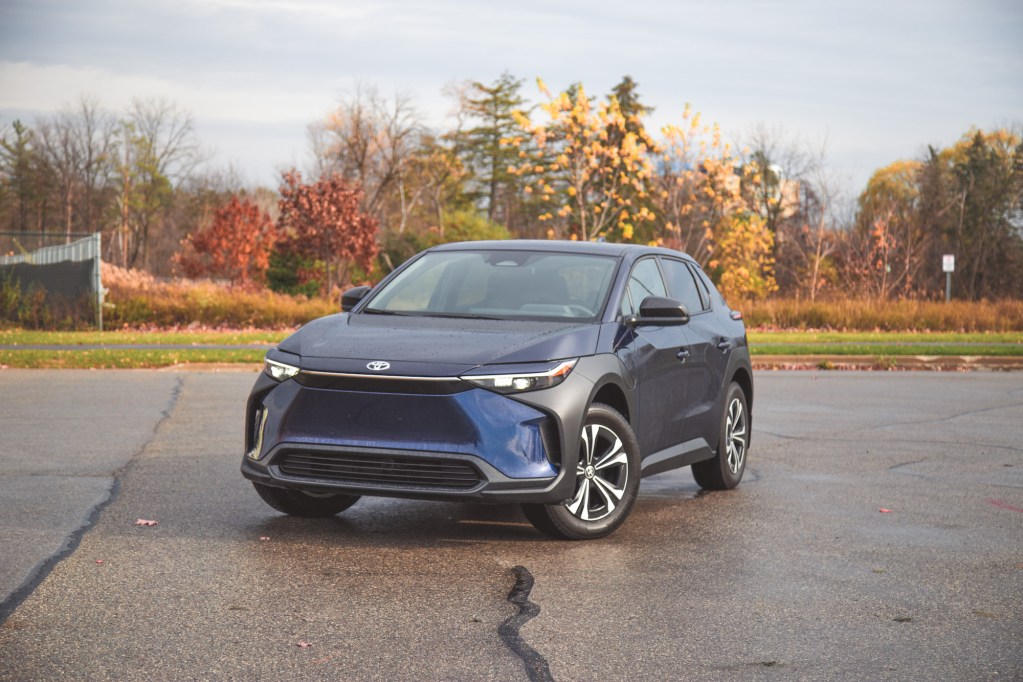
But Toyota says there is some logic to the rhyme. bZ stands for ‘Beyond Zero’ emissions, X stands for crossover, and 4 tells us that it’s the same size as a RAV4 (we had our bets on four-wheel drive). Alas, the bZ4X LE we drove was front-wheel drive only. AWD with an extra electric motor powering the rear axle costs more. It does produce 13 more horsepower, but its range is diminished to 367 km.
The FWD model we tested has a claimed range of 402 km. In our own real-world driving, our computer estimate hovered around 295 km during both city and highway driving. Turn the heaters off and drive like there are eggshells under the pedal, and you could likely stretch that to the low 300s. That’s not terrible for Toyota’s first foray into the fully electric space, mirroring other EVs like the Ford Mustang Mach-E (370 km), Volkswagen ID.4 (394 km), and the Subaru Solterra, which was actually co-developed with the bZ4X, and both are nearly identical aside from looks and price. Though the Subaru has an easier name to remember.

The starting price of $49,990 for the bZ4X LE is a bit of an ask, especially when compared with Toyota’s hybrids on offer, such as the Toyota Corolla Cross Hybrid ($37,474), RAV4 Hybrid ($39,035), and Venza Hybrid ($45,434). Take a look at your yearly mileage, calculate your potential fuel savings, and see if switching to a full BEV is even worth it, aside from the peace of mind.
That being said, without a noisy fuel-burning engine, the bZ4X is quiet on the road and you are nicely insulated inside your own little bubble. While it lacks any sort of personality, this small SUV is quick off the line, the 71.4 kWh lithium-ion battery working in tandem with the front electric motor to deliver 201 hp and 196 lb-ft of torque. The tires chirp and struggle for grip if you’re too quick on the gas but there’s a great deal of wallop once the rubber is warmed up. It does, however, quickly run out of breath past 100 km/h, dampening both the battery charge and the driver’s enthusiasm. The ride isn’t as compliant as that of a RAV4 Hybrid, likely due to its substantial curb weight. Its languid suspension is quite truculent at low speeds, and it struggles to balance both pitch and roll, but it’s not like the Mustang Mach-E or ID.4 handle any better.

The bZ4X is a dialled-down and accessible SUV catered towards those making their first jump to an all-electric ship, and while it’s missing the dexterity, connection, and engagement to call it fun to drive, we didn’t expect this Toyota to excel in those areas. Rather, it’s a testbed for EV demand, and Toyota opted to stick to its core values of ergonomics, reliability, and dependability, rather than chasing the newest technology.

This says volumes about the interior, which boasts a plain but cozy design. The novel dashboard houses a sunken-in instrument binnacle with a gauge display situated quite far away from the driver. It’s awkwardly elevated above chest height, so one must lower the steering wheel significantly. Otherwise, the wheel rim will block the view. You end up driving in a bus-like position with the bottom of the wheel near your thighs. Still, the seats are snug and comfortable once situated in, the cabin is airy and spacious, and the thin-rimmed wheel is packed with actual buttons and dials, something we greatly appreciate after spending time in the Volkswagen ID.4 with its half-baked haptic touch controls.

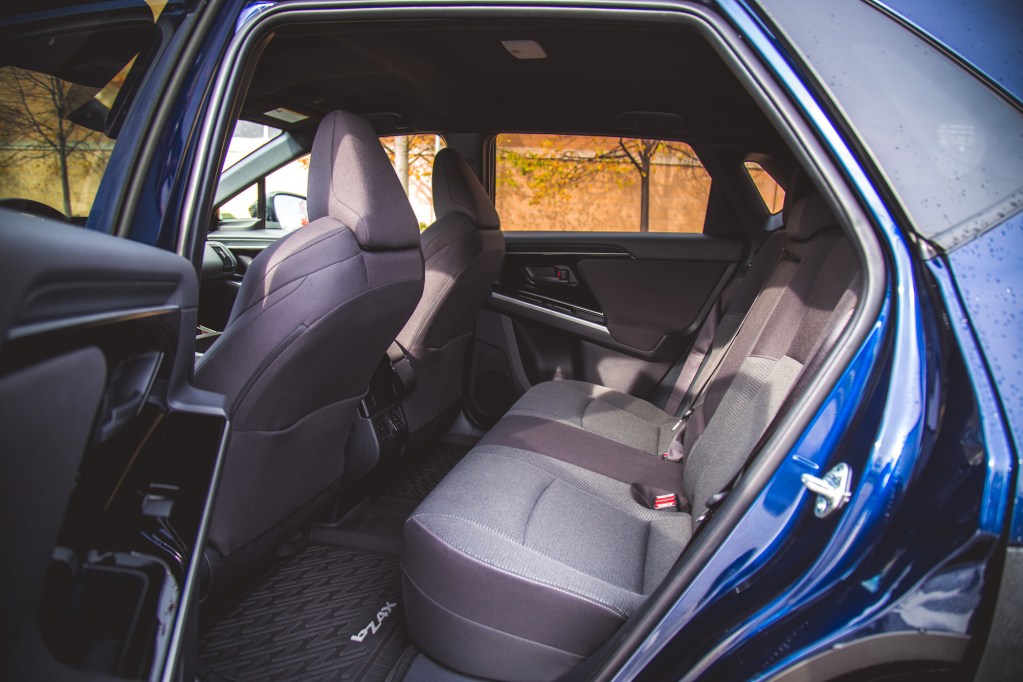
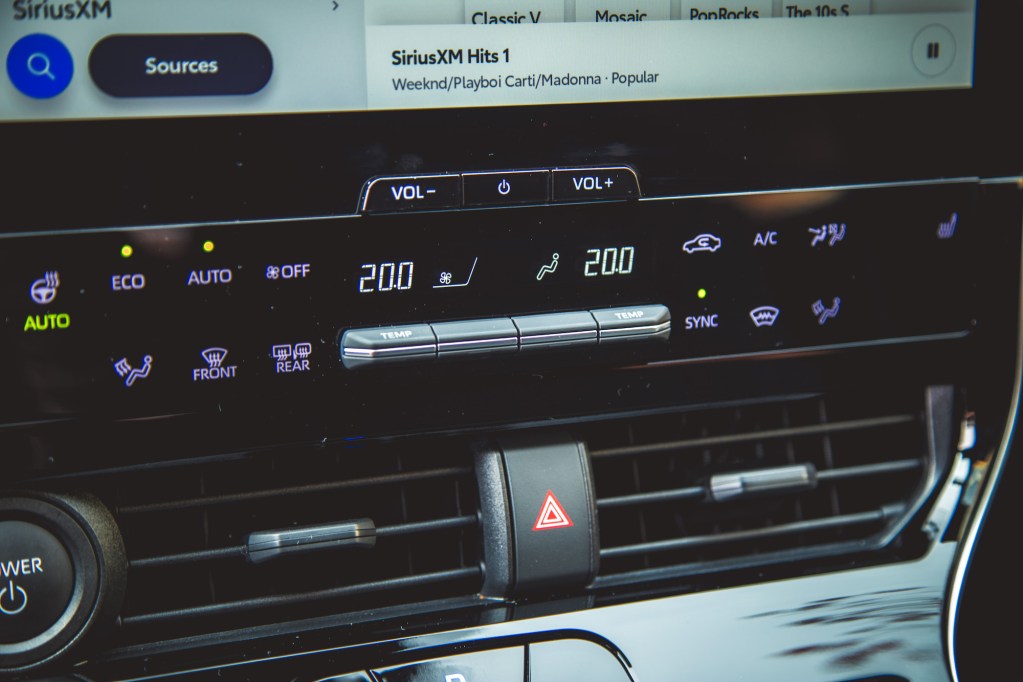
The 12.3-inch center touchscreen is bright, vibrant, and responsive, and its interface is easy enough to learn, though we still prefer hooking up our smartphone and enjoying the familiarity of Apple CarPlay. The center console appears clever but it reminds me of Mercedes ergonomics, with a frustrating lid cover that sticks out and blocks my wrist from accessing the heating controls. We would have preferred it if there were no lid covering the storage bin at all. Admittedly, it appears cleaner when closed but with the amount of items we constantly throw in there, 90% of the time it’s too full to close anyway. Rear seat space is decent but the RAV4 Hybrid has it beat in both legroom and trunk volume. Notably, the bZ4X does not feature a frunk.

Toyota is one of the largest and most successful automakers yet their hesitance on launching a mainstream fully-electric vehicle speaks volumes about their outlook on the future. Is developing massive batteries to power massive SUVs truly the answer, when sourcing those minerals is costly to the environment? Time will tell, but it explains why they’re late to the game, and why there’s nothing exactly novel or groundbreaking with the bZ4X. It fails to set off any incendiary grenades to draw Tesla or Ford back to the drawing board but it does set the stage for current Toyota hybrid owners to peep their next move into the all-electric space. In that light, the bZ4X is an affable and approachable bridging opportunity, and when driven with an iron-clad will of self-restraint, will even achieve a respectable driving range.
Specifications:
Model: 2023 Toyota bZ4X LE
Paint Type: Nautical Blue Metallic
Base Price: $49,990
Price as Tested: $49,990
Wheelbase(mm): 2,850
Length/Width/Height (mm): 4,690 / 1,860 / 1,650
Curb weight (kg): 1,920
Powertrain: 71.4 kWh lithium-ion battery, one electric motor
Horsepower: 201 hp
Torque: 196 lb-ft
Drive configuration: FWD
Claimed Range: 406 km
Observed Range: 295 km
Tires: 18-inch wheels







Leave a Reply