

Electric vehicles are becoming mainstream tools of transportation and high-performance variants are starting to creep into the fold, claiming exorbitant power figures and jaw-dropping acceleration times. The Rimac Nevera can reach a top speed of 412 km/h, while the Tesla Model S Plaid can sprint from 0 to 100 km/h in an equally insane 2.1 seconds. More attainable EVs, such as the Porsche Taycan Turbo S and BMW i7, further reveal the automotive tapestry of electric excess, but there’s clearly no shortage of desire.
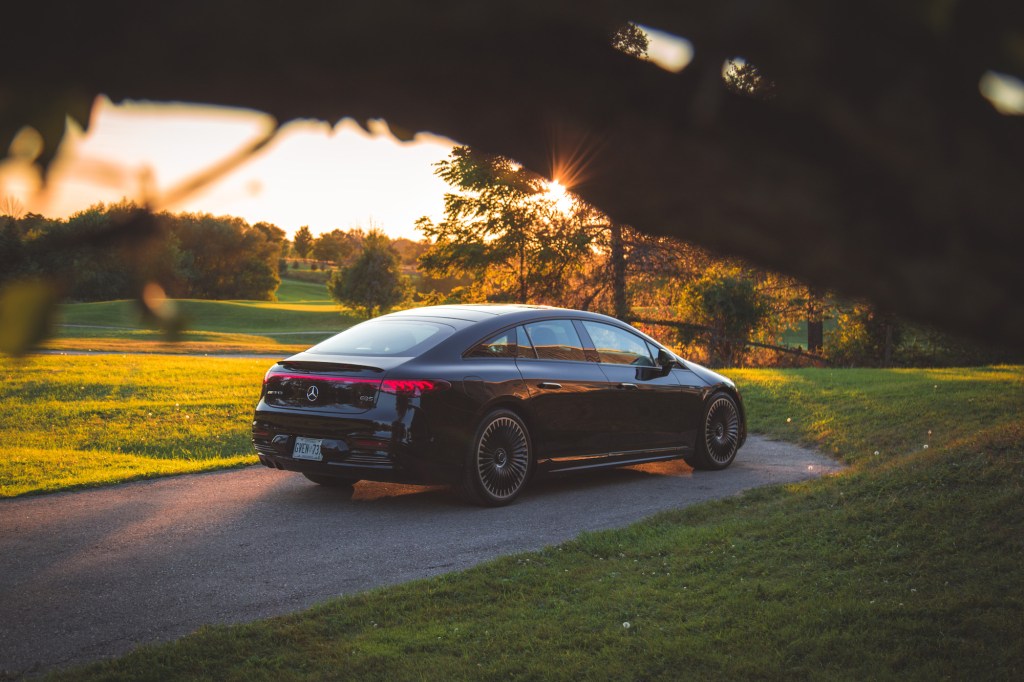
Mercedes-Benz is the latest to join the fray with the EQS AMG – also called the EQS 53 – the brand’s flagship electric sedan, boasting the same 107.8 kWh lithium-ion battery as the non-AMG EQS 580 but with two upgraded electric motors, one on each axle for an AWD setup. That’s enough to generate a grand 649 hp and 700 lb-ft, with a boost function activated by selecting Race Start, that temporarily ramps up those figures to 751 hp and 752 lb-ft. Like we said, excess. Twenty years ago, those numbers would normally be reserved for unicorns like the McLaren F1 or Ferrari Enzo. It truly is a new age, and the EQS wastes no time.

With all hands on deck, the EQS AMG ($195,000) will launch from 0-100 km/h in a scant 3.8 seconds, but Race Mode shaves that down to 3.4 seconds. That’s nearly a full second quicker than the EQS 580 (4.3 s, 516 hp, 631 lb-ft, $158,500), and more than two seconds quicker than the EQS 450 (5.6 s, 355 hp, 590 lb-ft, $136,000). While incomparable to the Tesla Plaid, this rather heavy AMG can keep up with the Taycan Turbo (3.2 s), Audi RS e-tron GT (3.3 s), and BMW i7 M70 (3.7 s).

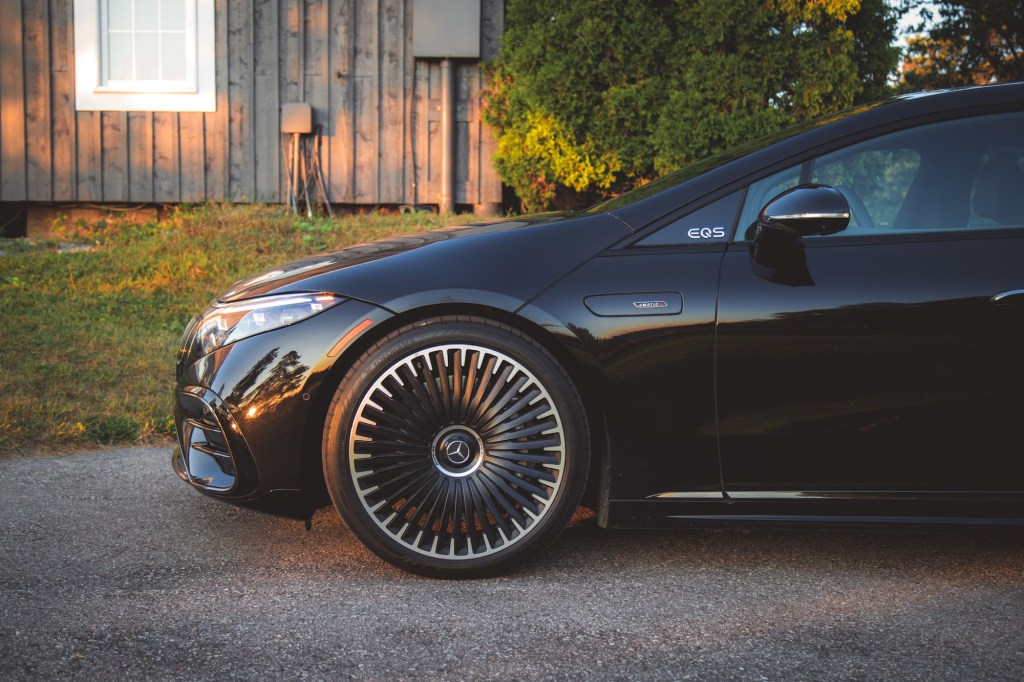
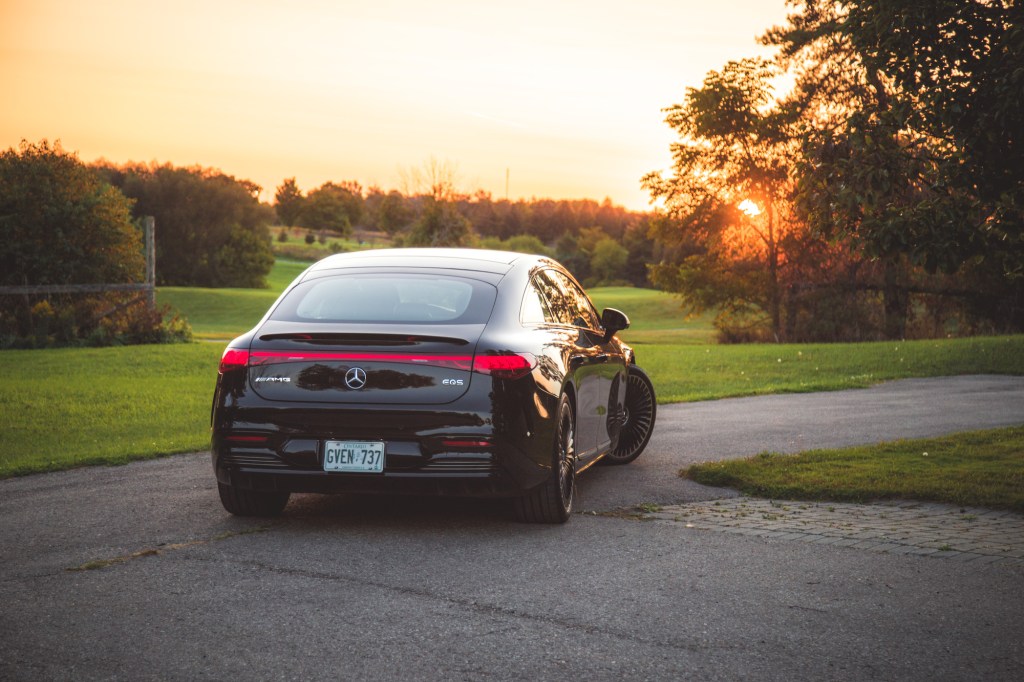
Mercedes claims a range of 446 km on a full battery and our own yield came close at an impressive 440 km with a mix of both city and highway driving. Notably, the rectangular port on the driver’s side fender with the 4MATIC+ badge is deceiving and is actually a slot for the windshield wiper fluid. The actual charging port is located on the passenger-side rear quarter panel.

But driving is about more than straight-line speed. It’s about cornering, steering communication, braking confidence, and driver engagement, areas where EVs typically fall short. And the same could be said about the EQS AMG. Despite its brand promise, it’s not a very cohesive driving partner. The performance is like a light switch: either on or off. There’s not much bandwidth in between, and the transitions are done in milliseconds. It’s exhilarating how violently this land yacht can launch when all four wheels are pointed straight, and it can put down the power effectively, but it doesn’t make it fun. It may be easy to extract the performance, but it hardly ever feels rewarding. We had the same issue with every anodyne Tesla model: lightning quick but a one-trick pony.
Fervent in acceleration but languid in the corners, the EQS’ overbearing ways of weight transfer mean you can’t lean on it in high-speed sweepers. Taming and reining in the body roll means carrying less speed and being more gradual and progressive with steering inputs. While it’s not as alienating and devoid of feedback as the Tesla, it doesn’t communicate the same amount of road feedback as the Porsche.

The brakes are far from reassuring, like pushing a wooden pedal flanked by an overloaded spring. There’s too much dead zone and pushback to the pedal resistance, much like in the Audi Q8 e-tron, which means there isn’t much braking feel that comes through, making it difficult to modulate smooth stops. You almost have to stand up and put your weight on the pedal to get them to bite effectively. The optional carbon ceramic brakes might solve that issue with some software fine-tuning, but $13,000 is a bit of an eye-wincing remedy.
Rather, it is the AMG’s suitably quiet cabin paired with a well-sorted ride that makes it a gleaming competitor. The adaptive air suspension reacts every 0.006 seconds for a nicely judged ride and excellent high-speed stability, even on these skinny 22-inch wheels with enough spokes to embarrass an Alpina B8 (34 spokes to be exact – yes, we sat there and counted). The EQS rides better than the Taycan and Tesla but becomes more unsettled with negotiating deep crevices or hard bumps that stress the dampers. Admittedly, it’s a far cry from the standard S-Class, which is like riding a pillow on wheels.

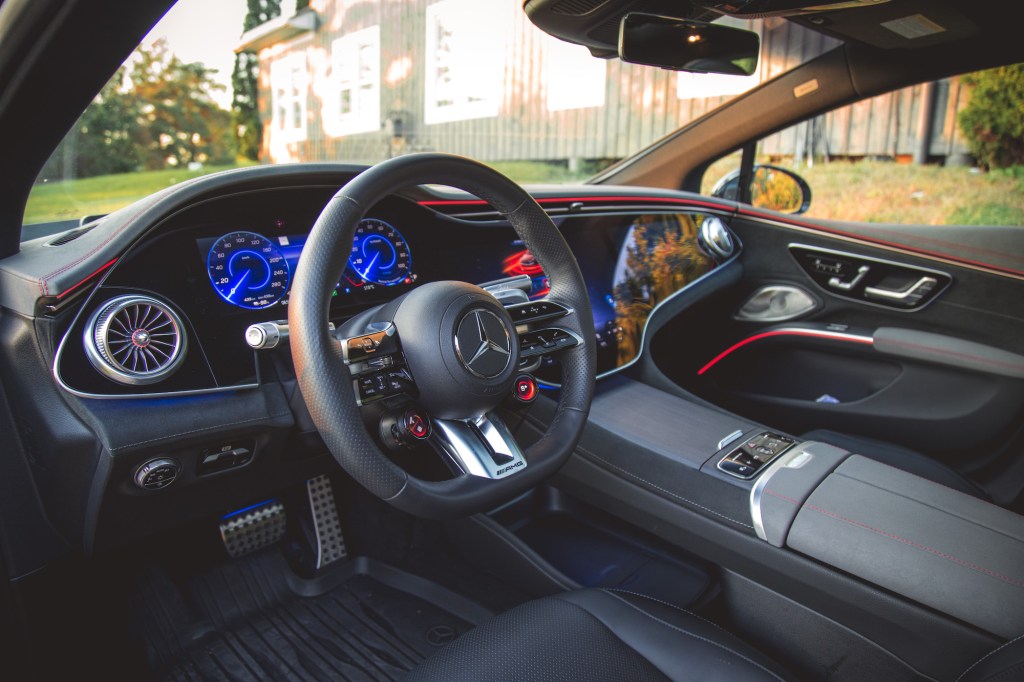
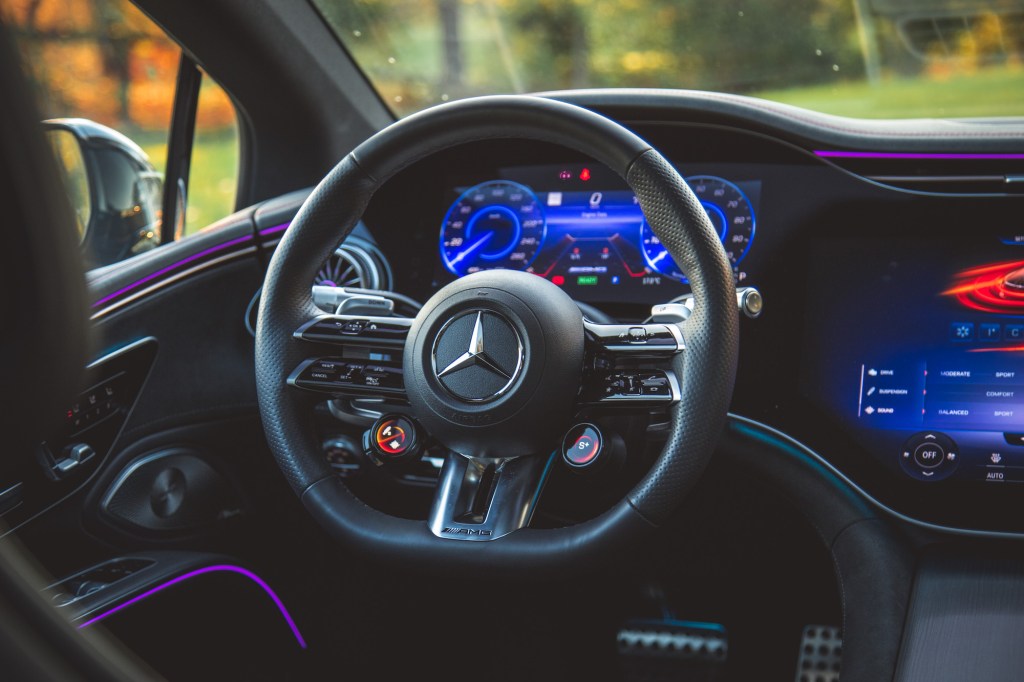
However, thanks to an innovative rear-wheel steering system that allows the rear wheels to rotate by a full 9 degrees, the EQS becomes agile and maneuverable at low speeds, almost too nimble. It forced us to recalibrate our approach and exit angles when parking to account for the EQS’ incredible rotative abilities. It takes getting used to, as do the three levels of AMG-synthesized ‘exhaust noise’ that induce the feeling of piloting a spaceship. It’s more akin to the sound of pod racers in Star Wars, just without Sebulba yelling and throwing wrenches at you. These can be selected via the round dial budding out of the steering wheel.
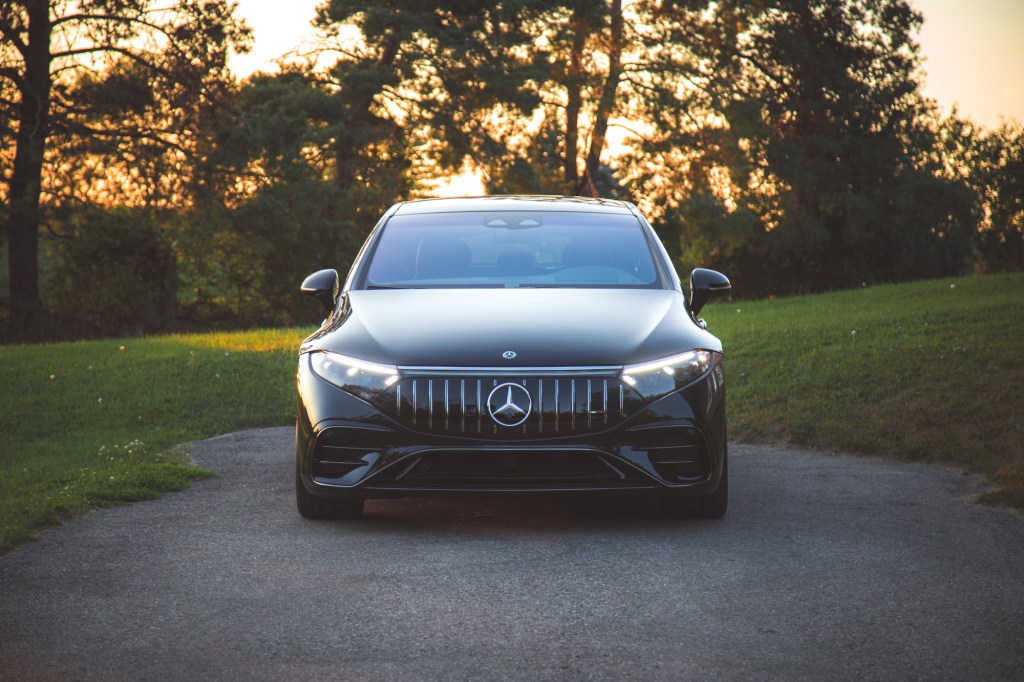
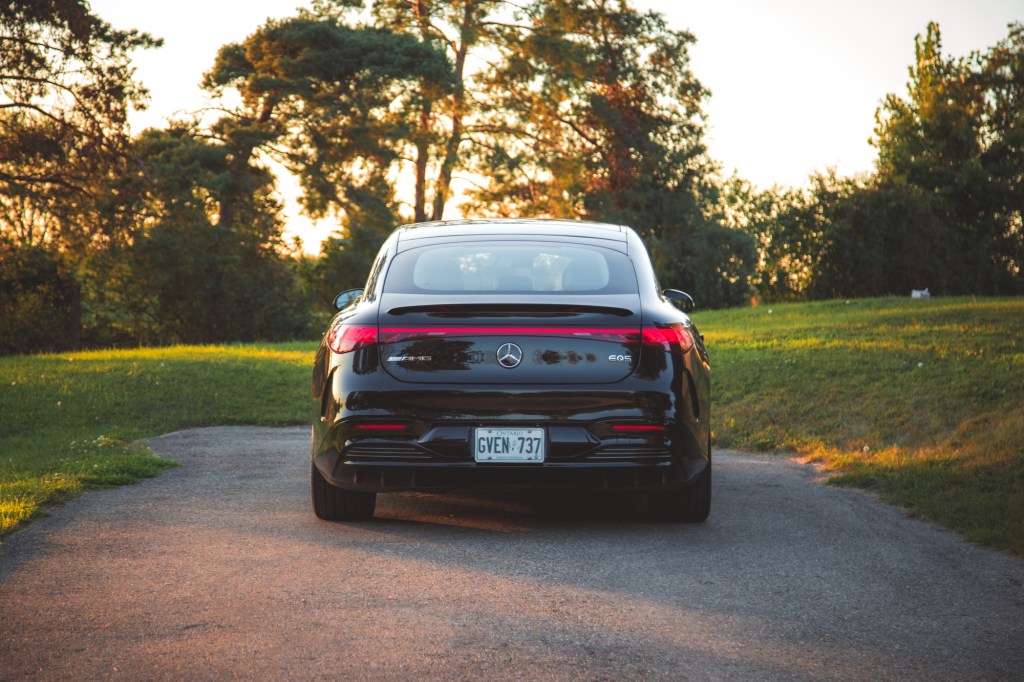
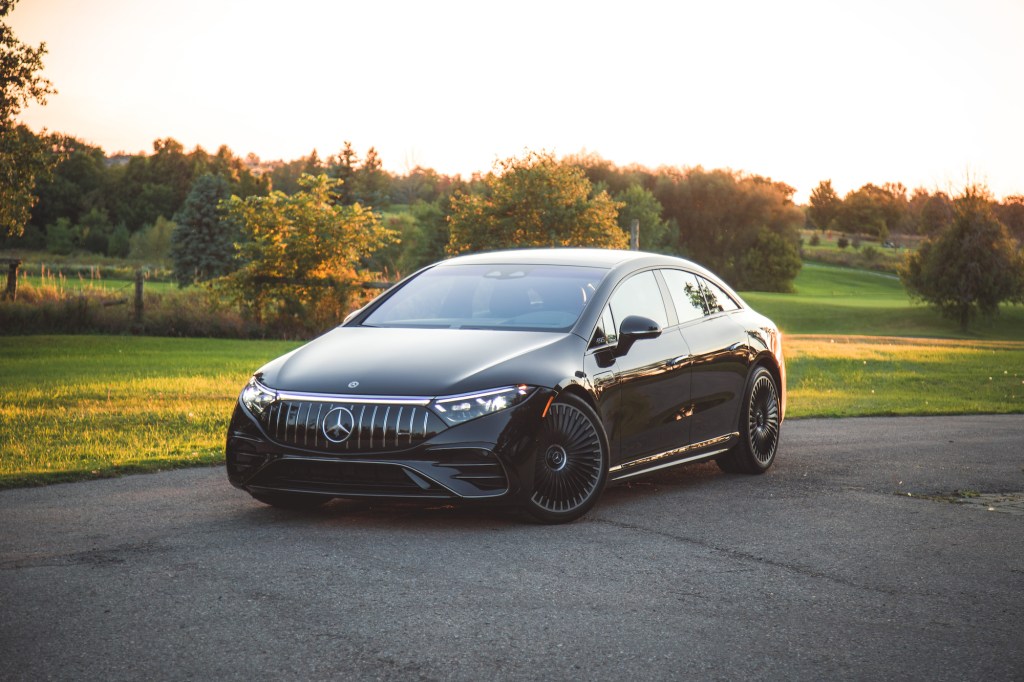
Some automakers call it a day once the performance objectives are complete but the EQS AMG arguably tackles the other departments – curb appeal, interior quality, and amenities – more successfully. Its slippery soap bar silhouette (say that ten times fast) is unique and AMG’s iconic vertical bars are slotted and stamped onto the grill, but the front fascia still looks like a Honda Odyssey with an Obsidian Black striped tuxedo.

The AMG receives mildly more aggressive front and rear bumpers, exclusive wheels, and a rear lip spoiler, but it’s otherwise challenging to distinguish from the non-AMG EQS. We would have preferred more camber and visual garnish. We already know the AMG variant will suffer from a diminished range, so might as well go big or go home.

We have to admit that Mercedes hosts one of the most uncreative and drab collections of paint colours available for their cars, even for a top-shelf AMG. The palette is heavily limited to blacks, whites, grays, dark blues and a random shade of bright red. Albeit, monochromes always look the best on Mercs but it sucks the creative mind out of the equation. We love seeing daring, bold, and tasteful colours on the road.
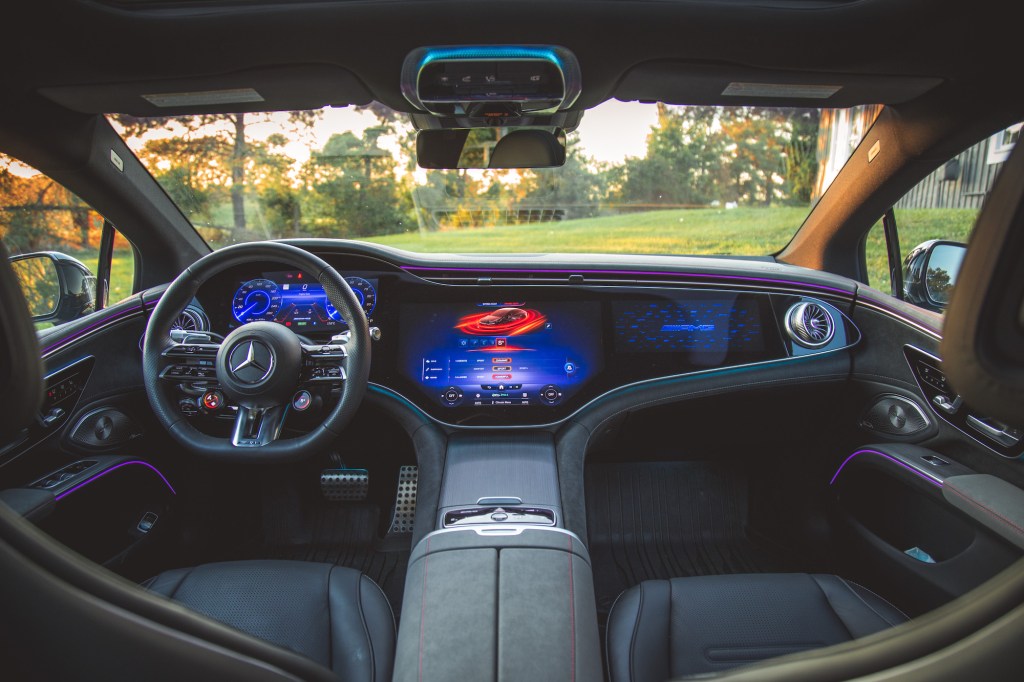
The interior dazzles with quality and an audacious show of digital real estate. Those coming from a Tesla will be overwhelmed and that’s no exaggeration. The cabin is not as theatrical as the BMW i7, literally, with its rear display mimicking a movie theatre, but the Mercedes hyperscreen is stunning. A single piece of glass spanning 56 inches creates a seamless display, accentuating the interior’s width and adding fluidity to the space. Add to that the 64 colours of ambient lighting and better screen definition than my OLED television, and it becomes a spectacle at night. And while these glass touchscreens are inherently prone to fingerprint stains, the ones here are fairly resistant to them and much better than Porsche’s. The front seat passengers also receive their own 12.3-inch touchscreen on the dashboard, similar to those found in the Jeep Grand Wagoneer and Ferrari 812.

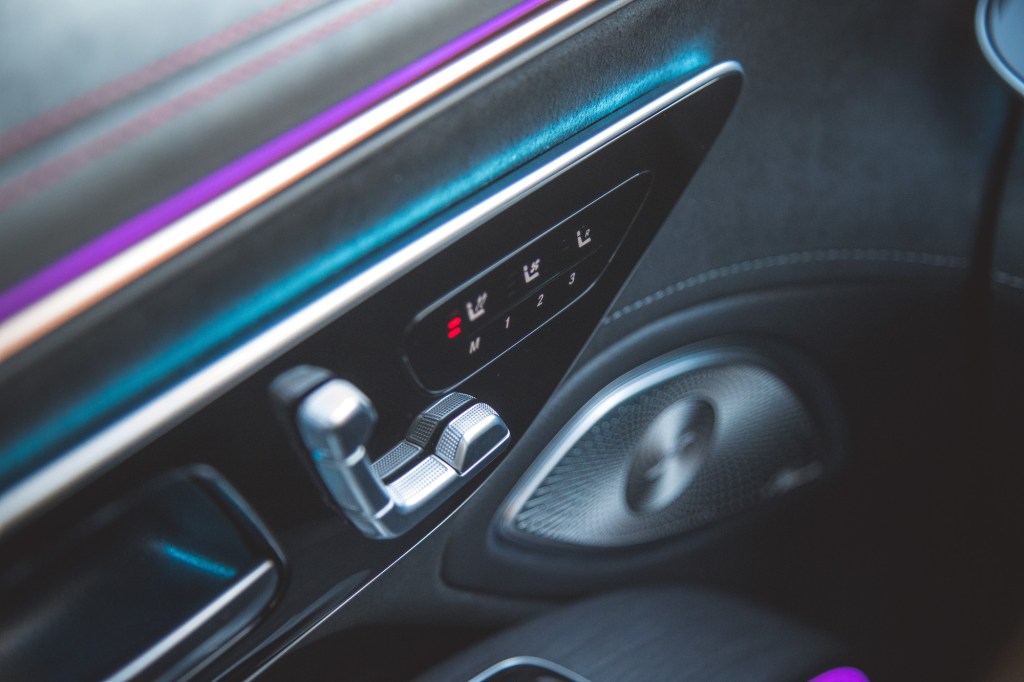
It’s a glitch-free interface but one that’s not terribly intuitive and can be difficult to digest for those used to the analog way of infotainment interaction. You won’t find any buttons or dials here, just haptic touch sensors. As sleek and seamless as they are, they lack any grooves or tactile borders, so you can’t really tell where that specific button ends. We had a frustrating time searching for the optimal way to push the buttons while driving but to no avail. The most infuriating of them is the seat control panel on the door. There are no grooves between each of the three memory seat buttons, and the panel is mounted vertically and angled away from the driver, so it’s unclear what you’re pressing. It’s a guessing game 90% of the time.
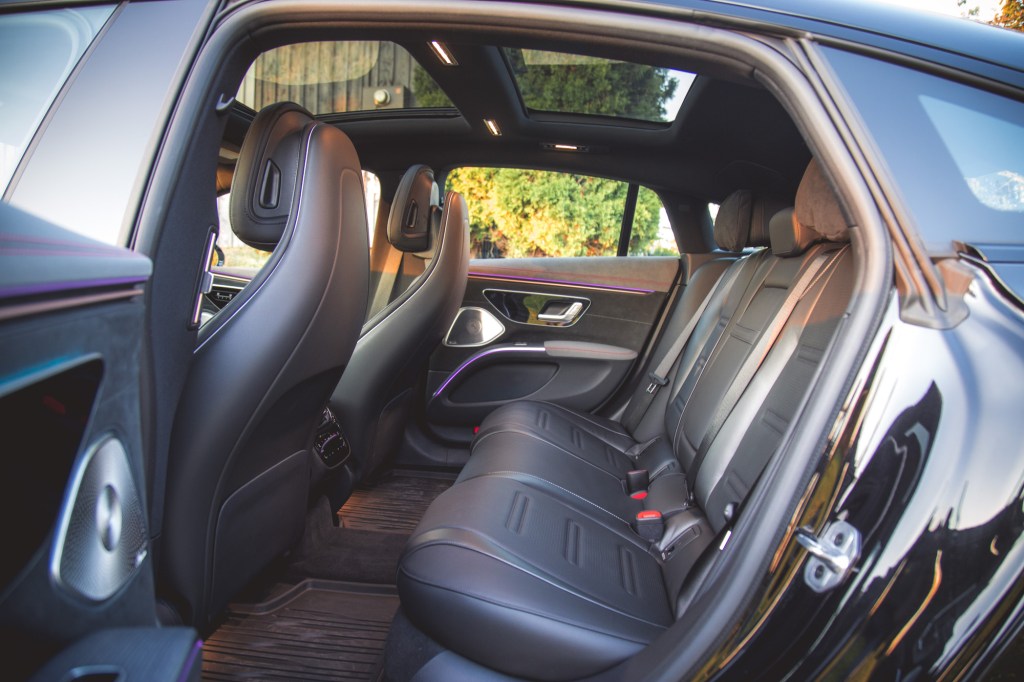
Without the Executive Rear Seating Package ($7,000), the rear seats of the EQS AMG are embarrassingly bare for an S-Class product. There are no heated seats, let alone seat recline. The short bottom cushion is tilted upwards so you sit with your knees up in the air, and the seatback is very upright, so you never feel relaxed. Not to mention the tiny door openings and sloping roofline, which cut out much of the usable headroom for my six-foot self. The rear bench in the Porsche Taycan is admittedly worse, and the Mercedes even has its own rear sunroof, headrest pillows, a middle seat, and generous legroom, but the awkward packaging compromises its appeal.
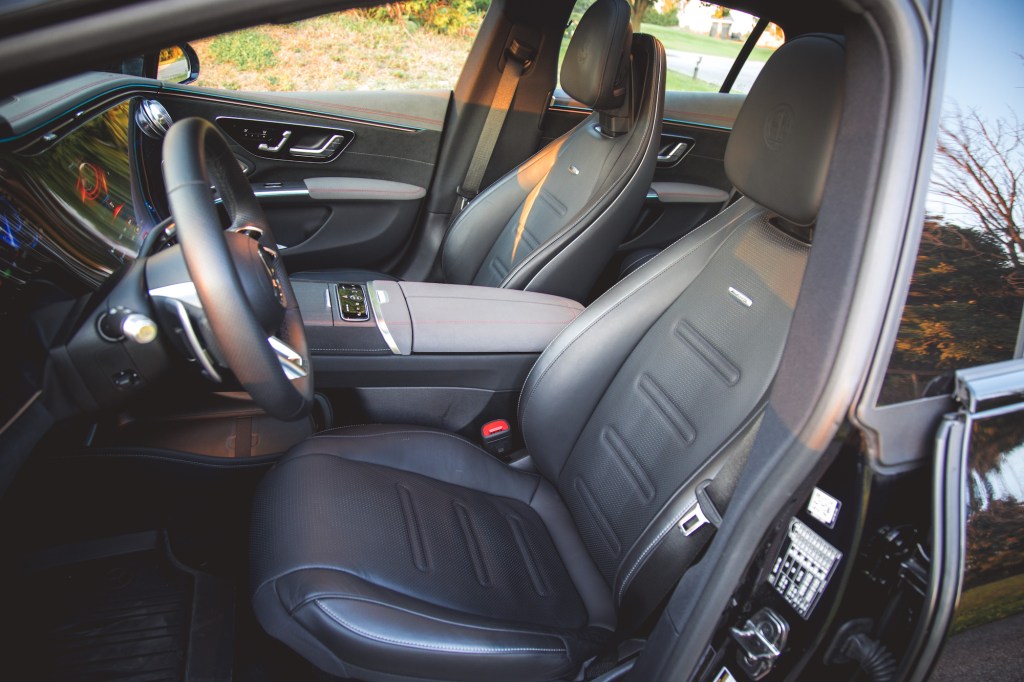
The front seats aren’t great either – awfully skinny with uninspiring headrests that look like the ones Playseat sells for sim racing (also with Mercedes badging). They’re not works of art like those in the S-Class, though they still come with every feature imaginable, from adjustable side lumbar support and heated, ventilated, and massage functions. But these aren’t the plush sofas we always look forward to sinking into with AMG products. And we’re not sure why the airbag cover is made of the same black, scratchy plastic as lower-rung AMGs. It’s almost unacceptable at this price point and should be leather. Great five-spoke wheel design, though.

The EQS AMG is a complex performance EV boasting wicked straight-line performance and a stunning silhouette that drips with road presence when spec’d correctly. However, we argue that the regular EQS is just as competent when you’re not trying to impress friends with organ-rearranging launch times. The EQS doesn’t offer the driver engagement that we expected from an AMG, and its poor interior packaging has us yearning for the more well-rounded EQS SUV instead. We think the upcoming, similarly priced, hybrid Mercedes-AMG S 63 E Performance would be the better buy, too, if you’re still hesitant about jumping over the electric fence with both feet. The EQS AMG Sedan, on the other hand, is designed for those seeking top-dog electric performance. It’s a prestigious, tech-filled, and highly effective tool, but with a painfully narrow bandwidth of driver reward and involvement.
Specifications:
Model: 2023 Mercedes-AMG EQS 4MATIC+ Sedan
Paint Type: Obsidian Black
Base Price: $195,000
Price as Tested: $198,030
Wheelbase(mm): 3,210
Length/Width/Height (mm): 5,220 / 2,125 / 1,512
Curb weight (kg): 2,655
Powertrain: 107.8 kWh lithium-ion battery, two electric motors
Horsepower: 649 hp (751 hp with boost)
Torque: 700 lb-ft (752 lb-ft with boost)
Transmission: Single-speed automatic
Claimed Range:446 km
Observed Range: 440 km
Tires: 275/35R22










Leave a Reply