
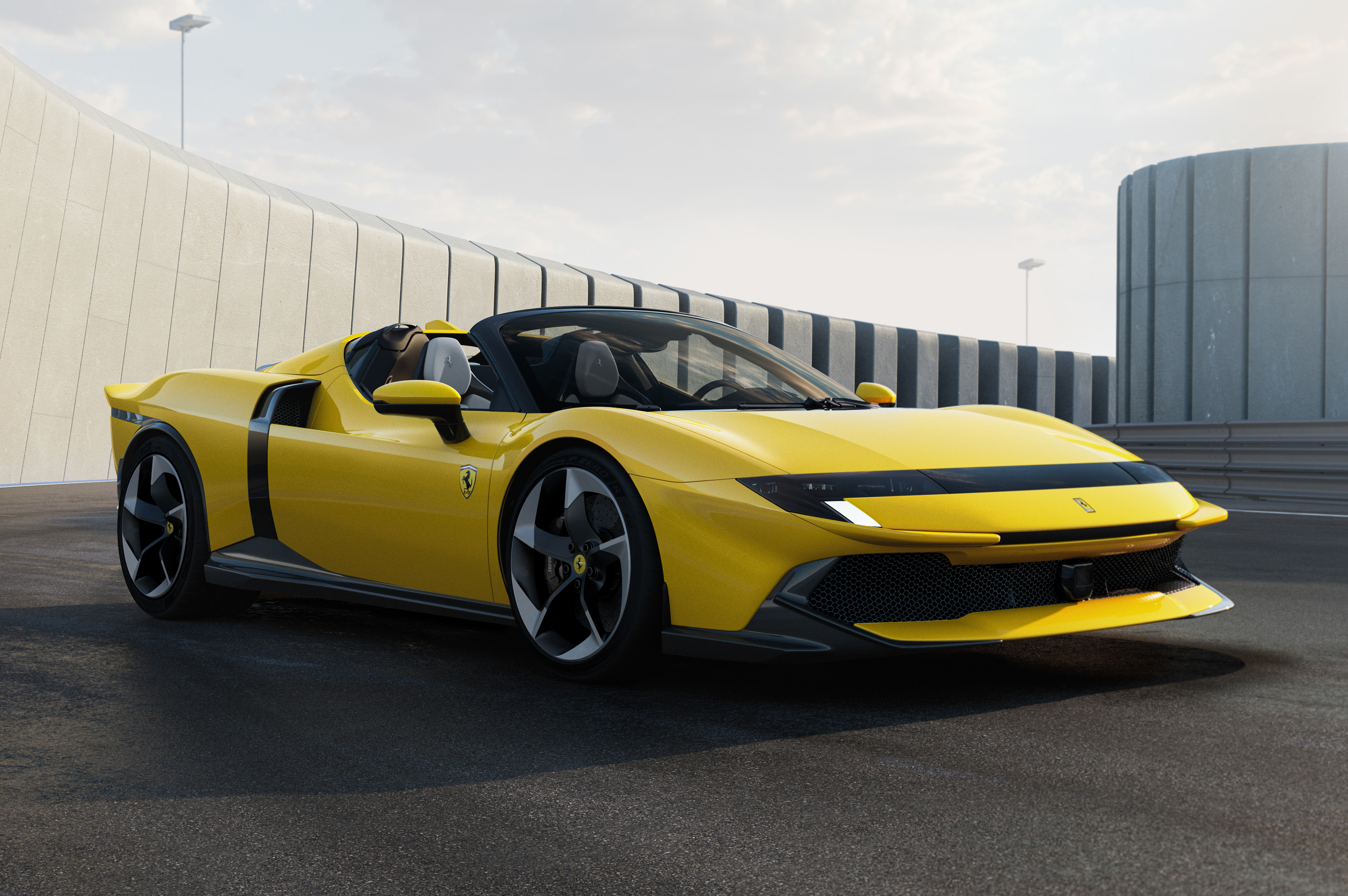
The ’80s are back in full swing with the new Ferrari 849 Testarossa. As automakers say, there’s no better drug in the world than nostalgia, but Ferrari’s latest mid-engined supercar is perhaps relying a little too much on the history and cultural significance of the original in an effort to boost the dismal sales and horrid resale values of the SF90 Stradale that it replaces. Without the retro Testarossa’s signature side strakes, pop-up headlights, and Monospecchio-spec single side mirror, we’re worried that Ferrari is falling victim to corrupted badge engineering, but tech borrowed from the F80 flagship and 1,036 horses on tap give us hope.

The slanted nose and hidden headlights give the 849 a modern look, but we have yet to warm up to the black bar that connects them, a thick unibrow design element borrowed from the 12Cilindri. It cannot be spec’d without it either – we perused the online configurator for an hour and found no way to paint it over. It’s a greatest hits album with a modern interpretation, a 12Cilindri grafted onto an SF90 with F80 rear lights, Daytona SP3 bumpers, and twin-wing sections from the 512 S that raced in the 1970 Daytona 24 Hours.

Ferrari has unquestionably listened to customer feedback—the updated cockpit remedies many of our previous concerns, most notably with the steering wheel. There are now physical buttons on the wheel, along with an actual start button that replaces those frustrating haptic sensors. The 849 also utilizes Ferrari’s latest infotainment system and equips the passenger side with its own digital screen.

Testa Rossa means ‘red head’ in Italian, and back in the 1950s, Ferrari used it to describe the red cam covers of their racing engines, which they still use to this day. While we have yet to peek under the 849’s engine cover, we are sure the intake manifolds are red, and Ferrari notes that the 8 stands for eight cylinders, and the 49 stands for 499cc cylinder displacement.

The powertrain layout remains the same as the SF90, with a mid-mounted 4.0-litre twin-turbocharged V8 paired with three electric motors, a 7.45 kWh lithium-ion battery, and an 8-speed dual-clutch transmission. Two motors are located on the front axle, and the third is integrated into the transaxle gearbox, operating like the MGU-K unit that Ferrari also utilizes on their current Formula 1 car. Electric-only driving is limited to 25 km.


Output has been raised to 1,036 hp and 621 lb-ft of torque thanks to new cylinder heads, engine block, Inconel exhaust manifold, intake plenums, and most importantly, a larger turbocharger that uses F80-derived low-friction bearings and a 296 GT3-derived heat shield on the turbine casing. This should improve power delivery, reduce turbo lag, and make the 849 sound better than the SF90. Furthermore, that 50-hp bump gets the Testarossa sprinting from 0-100 km/h in 2.3 seconds before topping out at 330 km/h.

Along with other thermal, cooling, and aerodynamic upgrades, the 849 is also available in Spider guise with a retractable hardtop and an extra 90 kg of weight. To recoup that penalty, we recommend the optional Assetto Fiorano package that knocks out 30 kg with an extensive use of carbon fibre and titanium materials for the seats, wheels, and body panels. It also adds lighter and stiffer suspension components and sticky Michelin Pilot Sport Cup 2 tires.

Will the newest Testarossa be as iconic and influential as the original? We doubt it, but there’s no denying the fact that its thermal and aerodynamic upgrades have a positive effect on performance. Whether or not that results in more driver engagement and enjoyment than the SF90 remains to be seen.
No word on Canadian pricing, but expect deliveries of the Coupe to begin in the middle of 2026, with the Spider following shortly after.




Leave a Reply