
Wagons are a rare breed in Canada, lurking in the shadows of gargantuan SUVs and pick-up trucks. Performance variants even more so. Long roofs haven’t become the norm here like they have in Europe or Asia, where owners tend to prefer a wagon’s lower center of gravity, superior driving dynamics, accessible cargo bay, unassuming performance, and smaller footprint. We get it, SUV drivers enjoy sitting higher up for a better view of the road and with it, a greater sense of safety and awareness. Yet, glimmers of hope for a sportwagon renaissance have begun to emerge in the last decade.

Volvo was one of the first to take the gamble, equipping their V60 Polestar with a pair of flippers and sending it to our shores. Then came Mercedes with the insatiable E 63 AMG Wagon, and Porsche with the Panamera and Taycan Sport Turismo. Audi and BMW quickly responded with the Audi RS6 Avant GT and BMW M5 Touring, the pair finally rid of their forbidden fruit status.


Both have shown up just in time, dressed in matching white war paint, laced with nuclear V8 engines that punch out north of 600 horsepower, accompanied by mellifluous exhaust notes, carbon ceramic brakes for unholy stopping power, and all-wheel drive for all-weather capability. The IMSA racing series also inspires them in their unique way, but we’ll get to that shortly. The comparison between these two nail-bitingly gorgeous estates is inevitable. Both are esoteric machines that fly under the radar and enjoy a discreet appreciation for being able to shuttle five humans comfortably at over 300 km/h. And you can complain all you want about the apocalyptic transition to dull electric vehicles, but we have now entered the golden age of performance wagons in Canada.

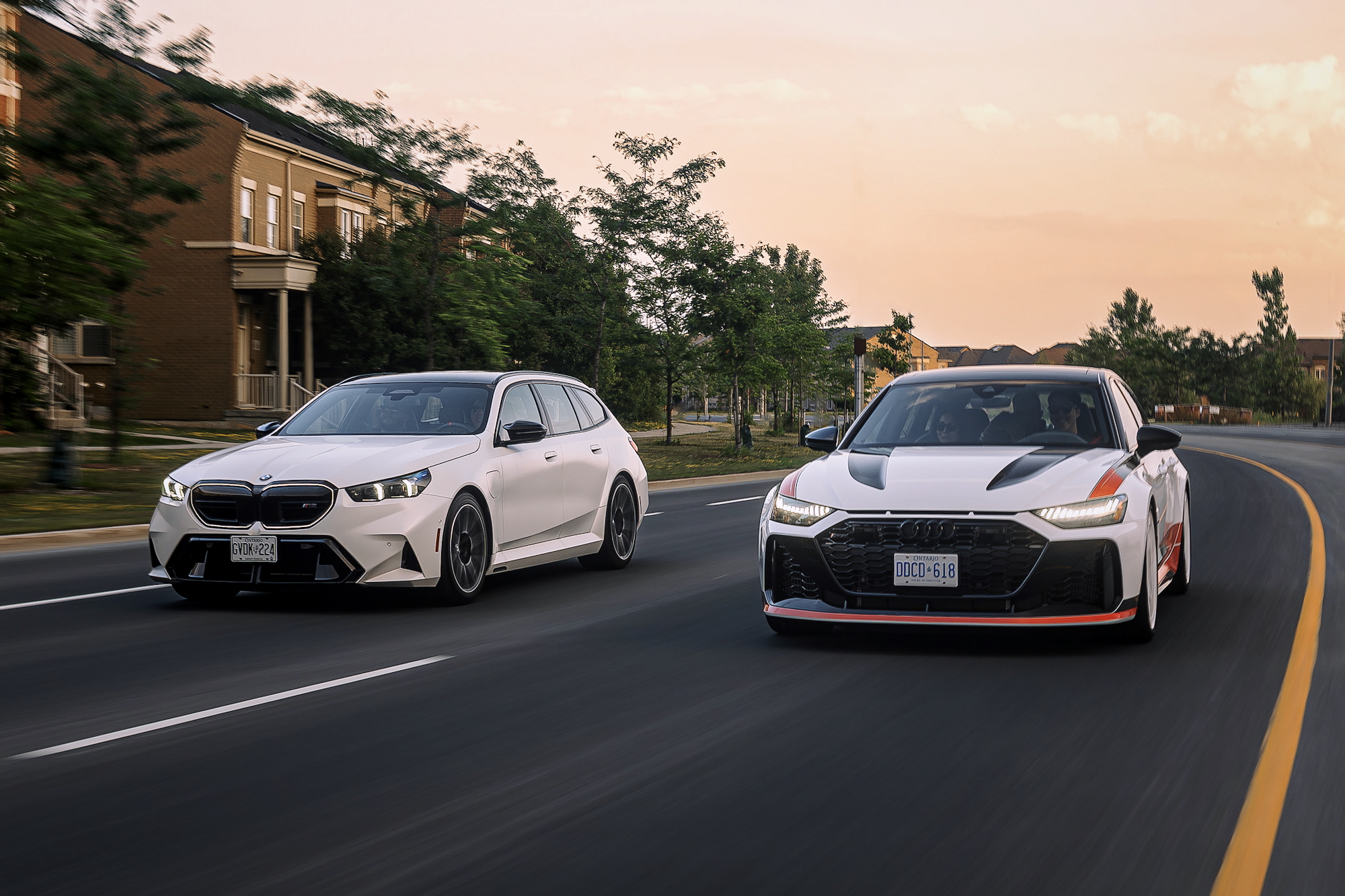
The Audi is a proficient neck-cracker but without a chiropractor license. Arkona White with matching white wheels is a godly spec, and this red, black, and grey livery takes it to another level. The RS6 Avant GT pays tribute to the Audi 90 quattro IMSA GTO from the late 1980s, a force that dominated its competition (but narrowly missed winning the title) with a 720-hp inline-five engine, turbo-chirping noises, and quattro all-wheel drive.

The GT starts at $249,785 with 660 copies destined for the global market, and only 7 for Canada. That’s a whopping $110,035 more than the 2025 RS6 Avant Performance ($139,750), nearly double the price. Not cheap, but neither is exclusivity. The extra penny does go a long way. After a standard RS6 is fully assembled at the production line in Neckarsulm, 660 destined examples are then sent to the Böllinger Höfe plant where the R8 and RS e-tron are made, and hand-assembled by seven experienced employees to create the final RS6 Avant GT. Reminds us a bit of the Alpina treatment. Although we wish the livery were painted on instead of this sticker set, especially considering the asking price, there are more inconspicuous specs available without the livery, in Nardo Grey and Mythos Black.

There’s a new pass-through roof spoiler that mimics the double spoiler in the 90 IMSA GTO, an updated diffuser, carbon fibre hood and fenders (the first on a production Audi) with the naked fibres discernible from behind the side vents, roof rail deletion, and Continental Sport Contact 7 tires wrapped around six-spoke 22-inch forged aluminum wheels painted in Ibis White and flanking carbon ceramic brakes, all of which reduce the curb weight by around 40 kg, and create a wagon with oodles of visual tension and geometric muscle that has us weak in the knees. Passion and sound decisions don’t often mesh but the RS6 makes a helluva’ good case for it.

The interior also receives a few upgrades with full Alcantara surfaces, optional carbon fibre bucket seats (ours has the standard seats that come with any RS6), and a serial number on the center console displaying the actual number rather than a generic 1/660. Ours was #385/660.


Unlike the BMW M5, the RS6 is not hybridized. Instead, it clings onto the volcanic embers of pure combustion with a 4.0-litre twin-turbocharged V8 engine delivering the same 621 horsepower and 627 lb-ft of torque as the standard RS6 Performance through its all-wheel drive system and 8-speed automatic transmission, but the GT revises the center locking differential that now allows up to 70% of torque to the front axle, and 85% to the rear. The rear differential has also been retuned, and the front and rear anti-roll bars are stiffer. The GT replaces air springs and adaptive dampers with manually adjustable passive coilovers that lower the ride height by 10 mm, a feature reminiscent of the Volvo V60 T8 Polestar Engineered, which utilized manual Ohlins shocks. The dampers here can be adjusted for both low-speed and high-speed compression, as well as rebound (our test vehicle used the default factory settings). The result is a 0-100 km/h sprint in 3.3 seconds, three-tenths faster than the M5 Touring.

By comparison, the BMW appears muted, devoid of features, and almost bare in this prosaic white paint, as if it’s ready for a fresh livery to be applied. But this unassuming shade of Frozen Brilliant White Metallic, which costs $6,000 under the BMW Individual program, is still attractive under the bask of golden hour glow, reflecting tints of yellow sparkles and faint blue hues, accentuating its oblique shoulders and extended silhouette that continues to summon fond memories of the E60 M5 Touring. Be that as it may, more vibrant hues like Daytona Violet or Laguna Seca Blue suit it better.

The G99 M5 Touring costs $138,000, $3,000 more than the Sedan. The Touring sits 6 mm higher and is 40 kg heavier, complemented by specific underfloor bracing elements, including a crossbar and shear panel, as well as stiffer areas around the luggage compartment. Additionally, the sunroof has been made wider, measuring 40 cm longer to bring more light into the rear cabin. There is 500 L of cargo space with seats up and an impressive 1630 L with seats down. For comparison, that’s 34 L more than the Sedan, and 100 L more than the X6 M.

Taking the blueprint from the BMW M Hybrid V8 LMDh race car that competes in IMSA, this M5 is equipped with a 4.4-litre twin-turbocharged V8 (S68) paired with a 14.8 kWh lithium-ion battery and an electric motor mounted within the transmission housing. Producing a combined 717 hp and 738 lb-ft of torque through an 8-speed automatic transmission to all four wheels, the M5 can reach up to 40 km on electrons alone.

Even with more power on tap, the M5 Touring weighs in at 2,485 kg, a substantial 265 kg more than the 2,220 kg RS6 GT. That’s like hauling another four average-sized adults, which is a plausible scenario for this family wagon. The result is a slower 0-100 km/h time of 3.6 seconds but BMW’s claimed figures are always conservative, and we wouldn’t be surprised if it were closer to the Audi’s 3.3 seconds.

Leave it to BMW to create an eminently refined interior. Taupe Grey over Deep Lagoon is a stunning spec and the dual-tone, matched with the adaptive ambient lighting, elevates the atmosphere from a Bavarian luxury item to a high-end Monaco nightclub. While it borders on superfluous, the Touring does come with a few hotfixes over the Sedan, namely in material quality. Instead of the cheap, scratchy plastics that cover the door panel switchgear in the Sedan, they’ve been replaced by a glossy piano black material that looks and feels like its six-figure price tag.


There’s something uniquely special about these performance wagons. They invite a more mature kind of buyer who desires an aurally and visually pleasing chariot but without the distasteful shoutiness of a mid-engined supercar, or the vulgarity and planetary gravity of a sporty SUV. The M5 exhibits this ethos the best. It maintains a low profile, with only two M5 badges visible from the exterior—a surprising and somewhat off-brand choice. Despite its weight, the M5 flourishes on twisty roads sprawled onto the map like a ramen noodle, welcoming a cresting off-camber turn with open arms, rotating with alacrity and mild oversteer. It has the chassis fluency of a smaller M3 but maintains that steadiness and rear-driven confidence even with its uprated output, showing flashes of brilliance with every downshift and crackle from the exhaust. We must also give credit to the Michelin Pilot Sport S 5 rubber. In its sportiest settings, some might find the damping too stiff, with low-frequency vibrations permeating the seats and steering, but it’s bearable and more comfortable than the Audi’s.

With all the gadgets and gizmos that go into this M5, enough to fill a few chapters in the manual, one would assume that this mechanical orchestra is too complex for its own good, but this is hardware and software singing in perfect harmony. The M5 never skips a beat. The gearbox is polished and doesn’t chirp or lag during low-speed transitions, its acceleration is frenetic but not skittish or edgy, and its boundaries are easily found, though exploring past them is where the M5 provides the most thrills. Disconnect the front axle, dial back the traction and stability control, and the M5 becomes a mercurial puppy that requires precise inputs and your full attention. It demands more from the driver.

The RS6 Avant GT is the complete opposite. In contrast to BMW’s overt personality, the Audi is a shy yet serious tool designed for racecraft. The GT’s limited-edition status and carbon fibre upgrades make it more akin to an M5 CS, so it might not appear like the fairest bout, but we believe it balances out the edge of the four-year-newer and more developed M5 Touring.

Right off the bat, we can tell it’s a sharper tool than the standard RS6. The new coilovers and more rear-biased differential significantly reduce body roll, the steering is more tense and determined, and it’s not as hyperactive or as excitable as the BMW. Selecting the GT-tuned Dynamic driving mode loosens the reins of the electronic aids, giving the Audi more rotational energy and greater throttle adjustability. The RS6 GT attacks corners with enthusiasm thanks to the new Continental Sport Contact 7 tires, its limits are more approachable than those of BMW’s, and it more consistently engages the driver. Audi cast a large safety net over the RS6 and it requires deliberate weight transfer to the front and a heavy dose of mid-corner throttle to get the tail stepping out, meaning you can confidently flex and take more liberties with corner entry speed. Consequently, we’re unable to pull off the same kind of inane maneuvers as the M5 when let loose, with calculated efforts to powerslide met with a disapproving nein.


These are hardships worth enduring because once you settle into a rhythm and begin to gel with a familiar road, you begin to appreciate how the spritely front-end scythes around corners while the rear unravels itself softly and gradually, preferring a tight-knit, well-choreographed dance, rather than the M5’s Tomorrowland rave. The Audi breathes with the undulations and feels more connected to the road thanks to its lighter curb weight and the thin-rimmed steering wheel that’s easier to grasp than the overly girthy BMW’s. It has a better steering feel, with more precise lateral movements, and it rarely leaves you nervous or uncertain, housing a breadth of capability that more effectively merges confidence with performance.

However, it’s the BMW that’s more proficient at dismantling broken roads. The RS6 rides stiffer with its KW-sourced coilovers and is tuned with more focus and purpose, whereas the M5 displays enough chassis fluency and flexibility to happily coddle you across the province. It has a more spacious interior and better seats, and it wouldn’t embarrass itself should there be a racetrack at the destination. Like its IMSA GTP counterpart, the twin-turbo V8 would feel right at home seeking the checkered flag, building and shedding speed like playing Gran Turismo on easy mode. With the aid and instant kick of those electric motors, an innocent prod of the gas pedal propels you into illegality within seconds, and it somehow feels quicker and more urgent than the Audi. This is a wagon made for the Autobahn, yet it’s also the more effortless, detached, and relaxed companion when you’re not in the mood for spirited driving.

The RS6 is simpler to operate but the M5 offers a more in-depth and customizable experience with its immeasurable list of adjustable settings. Finding your preferred setup requires experimentation and a manual of its own, or perhaps a team of qualified IMSA engineers to dissect and fully understand it. As much as we enjoy tinkering, the plug-and-play nature of the amiable Audi, the inability to adjust the dampers with quick button presses, and the way it hands you performance on a silver platter make it easier to accept and get along with on a daily basis.

The sounds emitted by the RS6 are more authentic and singular than the complex war drum offered by the dual-source M5. The Audi throbs on idle and revs with a conductor that faithfully follows the beat of your right foot. The M5 emits that addictive mid-range wail that begs you to downshift, accelerate, and repeat, but it’s less organic and somehow less pleasing with its synthesized noises.

These highly specialized carriages couldn’t be more different but they share a similar goal: to provide an effervescent and effective means of transport without sacrificing functionality or ergonomics. They each offer supercar performance in an unassuming guise. Fit for the family and fit for the enthusiast. In that light, the M5 and RS6 GT exceed expectations, leaving an indelible impression seared into our gearhead brains, and are mouth-watering prospects for any garage.


But their nuanced behaviours beckon to disparate camps of enthusiasts. The M5 Touring is an adrenaline rush that exhibits narcotic levels of driving nirvana. It’s been a while since a vehicle has fit our personal lives so perfectly – a double-shot of propulsive espresso at the touch of the red M1 button. It’s an emotionally stirring spectacle, like watching Usain Bolt sprint the 100m. The RS6 GT, on the other hand, is for the calmer and more collected individual, one who doesn’t always need to mark down elevens and provide a visual and audible business case for their presence on the road, even though this 1980s war uniform says otherwise, but can cleave through the opposition with moonshot accuracy. It’s more brains than brawn and is the hardcore runner of this duo, sprinting a half-marathon without its heart rate exceeding 40 bpm.
Sprint speed or stamina? To each their own but it’s the M5 Touring, as complex and overweight as it is, that consistently gets our heart racing for the checkered flag.
Specifications:
Model: 2025 Audi RS 6 Avant GT
Paint Type: Arkona White
Base Price: $249,785
Price as Tested: $249,785
Wheelbase(mm): 2,929
Length/Width/Height (mm): 4,995 / 1,951 / 1,460
Curb weight (kg): 2,220
Engine: 4.0-litre twin-turbocharged V8
Horsepower: 621 hp @ 6,000 rpm
Torque: 627 lb-ft @ 2,300 rpm
Transmission: 8-speed automatic
Engine & Drive Configuration: Front engine, AWD
Observed Fuel Consumption (L/100km): 18.2
Tires: Continental Sport Contact 7; 285/30 ZR22 XL
Specifications:
Model: 2025 BMW M5 Touring (G99)
Paint Type: Frozen Brilliant White Metallic
Base Price: $138,000
Price as Tested: $158,400
Wheelbase(mm): 3,006
Length/Width/Height (mm): 5,096 / 1,970 / 1,516
Curb weight (kg): 2,485
Engine: 4.4-litre twin-turbocharged V8 (S68), 14.8 kWh lithium-ion battery, electric motor
Horsepower: 717 hp @ 5,600 – 6,500 rpm
Torque: 738 lb-ft @ 1,800 – 5,400 rpm
Transmission: 8-speed automatic
Engine & Drive Configuration: Front engine, AWD
Observed Electric-only Range: 40 km
Observed Fuel Consumption (L/100km): 14.7
Tires: Michelin Pilot Sport S 5; 285/40R20 front: 295/35R21 rear



Leave a Reply