
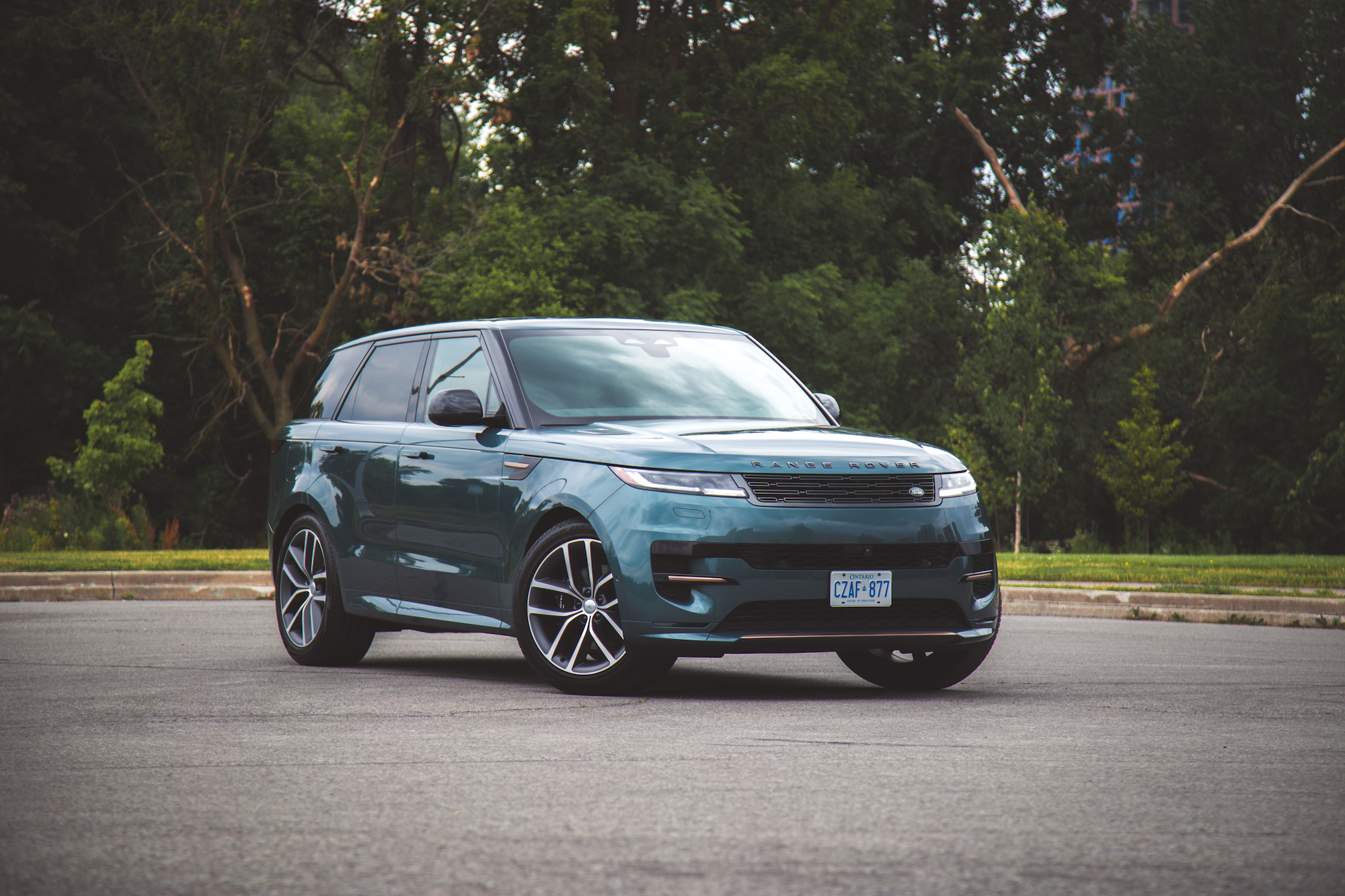
Whether it’s with co-workers, acquaintances, or family friends, things don’t always get off to a smooth start. First impressions can be a mixed bag, and we never quite gelled with the new Range Rover Sport. From the rear, it resembles the Nissan Pathfinder too closely, and it handles like an SUV designed for nautical duties rather than automotive ones. While its cabin is lavishly furnished with cowhide and massaging seats, we could never warm up to its pokey throttle response and jarring ride quality. That was the V8-powered P530 model.

However, we then drove the plug-in P440e and found that hybrid duties better suited its qualities, as did a quiet and calm zero-emission mindset. We are now testing the entry-level powertrain, the P400. It’s the same basic setup as the P440e but with a 48-volt mild hybrid unit instead. That means a 3.0-litre turbocharged inline-six engine producing 395 horsepower through an 8-speed automatic transmission, and a sprint time from 0-100 km/h in 5.5 seconds.

The P400 is a more polished unit than the P530. Though not as potent in the mid-range, it is much smoother with gentler transitions on- and off-throttle. Acceleration can feel tepid below 3,000 rpm though, making you feel somewhat vulnerable in traffic and on highways, but switching to Dynamic mode solves that, putting the engine and suspension into high alert, and providing more rapid thrust than the V6-powered Porsche Cayenne, but it’s still more glacial than the six-cylinder BMW X5. At least the exhaust emits a throaty roar when you wring it out at wide open throttle. The P400 is surprisingly fuel-efficient as well. We achieved 10.8 L/100 km with a mix of city and highway driving, not far off the 10.2 L/100 km in the P440e on an empty battery.

The Range Rover Sport rides fairly well on its adaptive air suspension and received praise from our passengers on its cloud-like feel. The Sport easily skips over broken surfaces with plenty of suspension travel to play with, and it flows over poor surfaces with confidence. It certainly fared better over bumps than its P530 compatriot.

Any green-on-tan spec is a spec worth praising. It looks phenomenal on the Range Rover Sport and significantly elevates its curb appeal. Giola Green harbours more teals and blues into its shimmer, and is less of the British Racing Green that you might expect, but it’s stunning when paired with the Caraway Windsor leather. Smoother and sleeker though less muscular than the outgoing model, the new Sport follows the brand’s new design language brought forth by the Evoque and Velar, but the rear comes off as somewhat generic and anonymous, and we wouldn’t blame you for mistaking one for a Nissan Pathfinder. Minimalism and soft shapes are all the rage these days but we think the sheetmetal is too conservative and too difficult to distinguish from the other models in the range (no pun intended).

Take the full-size Range Rover cabin and shrink it to 75% zoom magnification – that’s the Sport cabin in a nutshell. Aside from their dimensions, the only noticeable differences are the slanted center console and a smaller steering wheel, the latter of which feels more compact to grasp. The design and upholstery in this cabin are impeccable, with buttery leather covering the majority of surfaces. Complementing it is a large 13.1-inch curved center screen and a 13.7-inch digital instrument cluster.

The brown leather adds a deserving splash of colour and showcases its finely crafted steering wheel with a leather airbag cover, cozy couch seats, and adjustable armrests. An improvement over the outgoing Sport are the flat window sills that make it easy to rest your arm on like in the full-size Range – it used to be acutely angled. And typical of Range Rovers, the cabin is extremely well insulated from unwanted noise, muting out wind and tire squeal better than any in its class.

The 2024 model features several cabin updates, all of which impact user functionality. To streamline and minimize cabin clutter, the center console now only houses the gear shifter and start button. Where have the dials for the volume and drive modes gone? And what about that auxiliary panel that controlled cabin heating and the vents? Straight into the recycling bin, as every button’s functionality has been relegated to the 13.1-inch center touchscreen. On the left and right edges of the screen are volume and cabin temperature sliders – swing your fingers along them up and down to adjust.

On paper, that sounds fine and dandy. That’s what the touchscreen is for after all. The full-size Range Rover now features the same layout as well. But in reality, the loss of quick access via direct and dedicated buttons is frustrating. Taking your eyes off the road to adjust these high-traffic functions is annoying, and while there are multiple avenues to achieve this goal through voice recognition and steering-wheel buttons, we don’t think it adds any value to the experience. The cabin certainly doesn’t appear any better without the hard buttons and dials. A step in the wrong direction, we think, but it’s not just Range Rover falling victim to this trend. Volkswagen’s newest offerings suffer from an even more dire consequence as a result of poor user ergonomics and an over-reliance on haptic touch sensors.

The P400 powertrain suits the Range Rover Sport better than the P440e and P530, thanks to its polished transitions on and off the throttle. Acceleration is decent, but its surprising fuel efficiency has both the BMW X5 and Porsche Cayenne beat. Despite its lukewarm appearance, a green-on-tan spec partially addresses that issue, and when furnished with supple leather seats and an excellent infotainment system, the Sport is slowly becoming an imperious and attractive offering. Like many things in life, it just takes time to warm up to it. Maybe we’ll feel the same about the lack of a volume or temperature dial in due time.
Specifications:
Model: 2024 Range Rover Sport P400 Dynamic SE
Paint Type: Giola Green
Base Price: $108,900
Price as Tested: $127,275
Wheelbase(mm): 2,997
Length/Width/Height (mm): 4,945 / 2,047 / 1,821
Curb weight (kg): 2,309
Engine: 3.0-litre turbocharged inline-six engine
Horsepower: 395 hp @ 5,500 – 6,500 rpm
Torque: 406 lb-ft @ 2,000 – 5,000 rpm
Transmission: 8-speed automatic
Engine & Drive Configuration: Front engine, AWD
Observed Fuel Consumption (L/100km): 10.8


Leave a Reply