
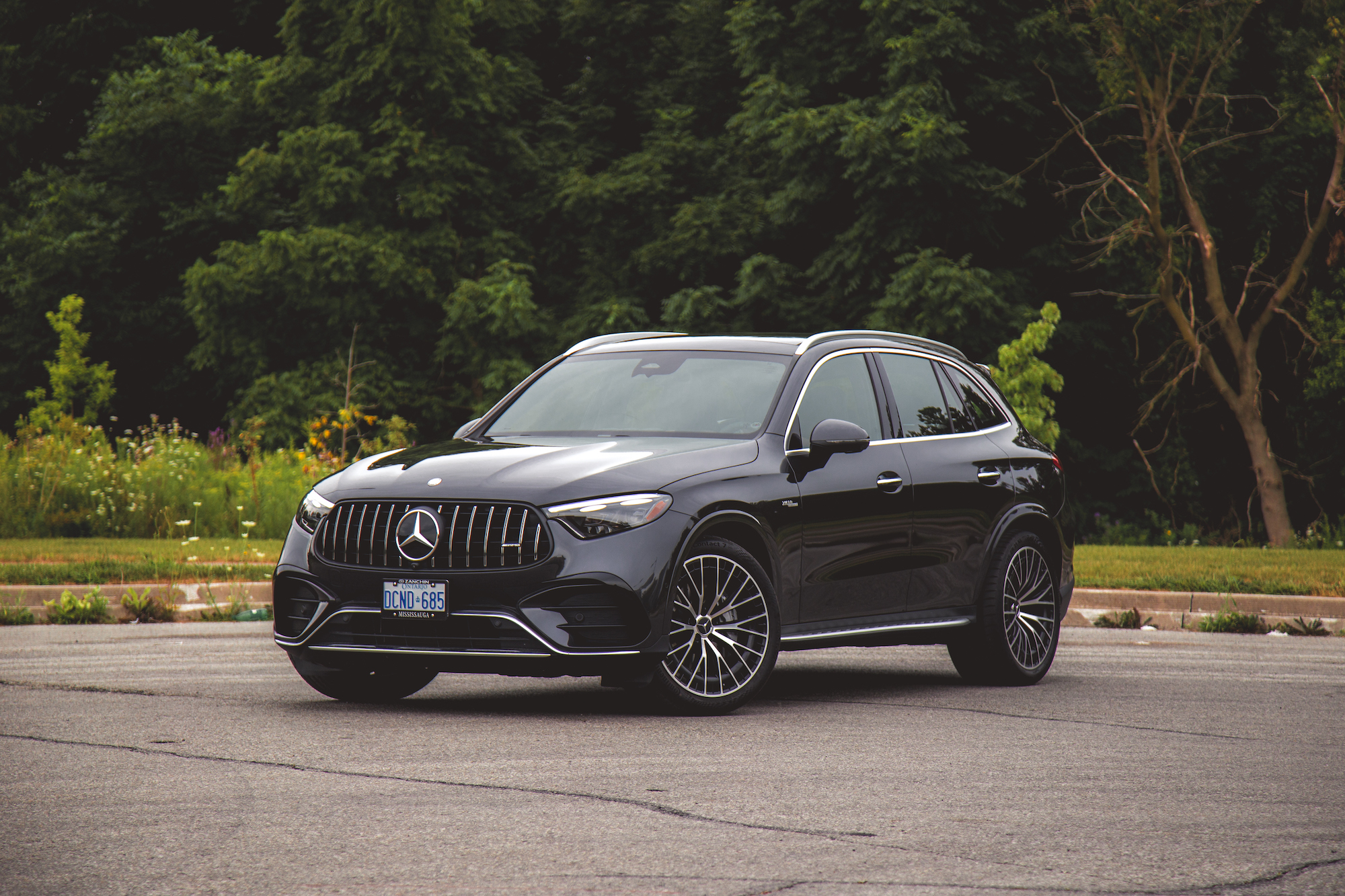
Mercedes has begun the arduous task of electrifying their powertrains and the latest to receive a healthy jolt of electrons is the 2024 class of GLC. The standard GLC 300 still uses a combustion-only turbo-four engine but the GLC 43 AMG you see here is categorized as a mild hybrid. It’s only until you get to the hardcore GLC 63 AMG do you get a full plug-in hybrid experience.

Like the C 43 AMG, the GLC 43 is a product of downstream principles. Everything Mercedes has learned from their Formula 1 program has trickled down to this. That’s as good of a marketing tool as it gets. And it’s not unique to Mercedes. Maserati applied its F1 learnings of pre-chamber ignition to its MC20 supercar, and Ferrari also developed a semi-automatic gearbox that eventually made its way to their road cars.

Down-sized but not down-tuned, the GLC 43 employs the M139 engine from the CLA 45, a 2.0-litre turbocharged four-cylinder but with added F1 trickery. The GLC 43 is the first SUV to utilize an electric exhaust-gas turbocharger, whereby a small electric motor spins up the turbo before the exhaust gases flow in, eliminating turbo lag and improving power delivery. It’s paired with a 48-volt mild hybrid system consisting of a starter-generator that handles the car’s auxiliaries and delivers a brief burst of 13 horsepower at low RPMs.

The GLC 43 now boasts 402 horsepower and 369 lb-ft of torque, which is 17 hp more than the outgoing GLC 43 and its twin-turbo V6, but also 14 lb-ft in the red. As such, the new GLC 43 is one-tenth of a second slower from 0-100 km/h – the penalty of two fewer cylinders and a missing turbo. But acceleration isn’t everything and fuel efficiency should be a major benefit with the smaller hybrid engine. However, unlike the C 43, which yielded a decent number, our GLC 43 only showed 11.8 L/100 km. We expected more. Even the Mercedes E 450 Sedan, which we recently drove, yielded a more efficient 10.8 L/100 km. But then again, the last V6-powered GLC 43 we drove averaged a paltry 13.1 L/100km.
On a positive note, this is the first -43 Series engine to follow AMG’s ‘One man, One engine’ philosophy, and it’s handcrafted by just one person. Though we’re not sure how this will transition over to the electric age. One man, one battery just doesn’t have the same ring to it.

When pushed hard, this turbo-four is a peach of an engine. It’s characterful, snappy, and full of power and responsiveness. 402 horsepower feels like the right amount for this platform, every one of them accessible, extractable, and within reach of the average driver thanks to sticky Michelin Pilot Sport 4 tires and all-wheel drive. You can keep your foot pinned on the throttle at reasonable speeds, chuck the AMG around a corner, and not have to worry about any snap oversteer or a sudden break of front-end grip that transitions into butt-clenching understeer. It’s a well-sorted piece of kit that feels right at home on the street.

It sounds great too. Although not as silky smooth in acoustics as the -53 Series inline-six, the GLC 43’s vocals are snotty, burbly, and deeper-toned, and are very enjoyable to listen to as the revs fizz and build to the 7,000 rpm limiter. Open the exhaust via the dedicated button and the engine will even rumble and rattle at idle – it’s like a mixtape of a Subaru WRX duking it out with a Fiat 500 Abarth.

But that’s about where the good news ends. Dial back the throttle inputs and begin to cruise at regular speeds, you know, the speeds that we normally drive as law-abiding citizens, and the powertrain begins to fall apart and show its weakest areas. Acceleration is disjointed at low speeds, lacking the fluidity and polish found in the regular GLC 300. The 9-speed gearbox is jumpy, delivers fragmented shifts, especially during rolling stops and as with other AMGs that employ this unit, it utilizes a wet clutch instead of a torque converter that carries the advantage of being lighter and more compact, but it’s not as willing and obedient as the 8-speed auto in the BMW X3 M40i.

The inconsistent brake pedal further taints the experience. The brakes are non-linear in feel and too sensitive on the initial press of the pedal, erasing any confidence you might have in achieving a predictable stop. The silver lining to these issues is that the roughness melts away when you drive it quickly like you’re on fire – the gearbox tightens up and becomes more forgiving, and slamming on the brakes lets its stopping power shine through, but this should have been this AMG’s redeeming factor, the fact that it could balance both sport and comfort in an uncompromising package. Those who wanted more comfort would go to the GLC 300. Those who wanted more sport would spring for the GLC 63. Those who wanted something in between would find solace in the GLC 43. The fact that it’s not leaves a sour taste in our mouths.

We must admit that this generation of GLC is the best it has ever looked. The design language is clean and stands out more effectively than previous models, thanks to a less generic silhouette. Still, we have to give the award to the GLC for the worst-positioned running boards of all time. They stick out way too much that the back of our pants always graze them, yet they’re too thin to be useful even for dwarves. Top tip: avoid opting for the running boards.

The GLC boasts an incredible interior layout. The center console cover no longer impedes the cabin flow and the screen is the perfect size and at the optimal angle for easy reach. The leather and suede steering wheel is a highly recommended option, part of the AMG’s Driver’s Package ($4,000), which also includes 20-inch wheels, a raised speed limit to 265 km/h, and an AMG Track Pace app. Dials with small screens bud out of the bottom spoke,s which can be used to adjust preferred drive settings like the exhaust, manual shifting, or even driver assistance features like the front view camera or fuel consumption. The wheel has the same five-spoke design as other AMGs but in this price bracket, the plastic airbag cover feels acceptable, not so much in the EQS AMG we just tested that costs more than double. It really should be leather at that point.

And while Mercedes has done away with analog clocks in their vehicles, there is a new IWC stopwatch display in the driving menu that shows a clock face, allowing you to play around with lap times or simply use it to tell the time. We dig it, even though we would much prefer an analog one, like the ones still found in Porsches and Bentleys.

The GLC 43 AMG is a performance-driven SUV that excels in road appeal and interior garnish. While we expected it to masterfully balance the art of comfort and performance in an uncompromising package, we found the GLC 43 to be neither comfortable nor particularly smooth in sporty driving. The gearbox tuning is genuinely dim-witted and the throttle and brake mapping are inconsistent and half-baked.

Unfortunately, this criticism also applies to the C 43 AMG Sedan, which utilizes the same powertrain but fares slightly better thanks to its lower center of gravity, lower curb weight, and lower price. In this heated SUV segment, however, with the ever-charming Alfa Romeo Stelvio Quadrifoglio looming around the corner, the BMW X3 M40i showing what it means to be a smooth operator, and the more well-rounded Porsche Macan GTS breathing down its neck, the GLC 43 AMG is difficult to recommend. It may be inspired by Formula 1, and it may be more complicated and complex than we mere mortals can understand, but out on the road, we’re still left wanting.
Specifications:
Model: 2024 Mercedes-AMG GLC 43 4MATIC SUV
Paint Type: Graphite Grey metallic
Base Price: $79,900
Price as Tested: $102,133
Engine: 2.0-litre turbocharged four-cylinder, 48-volt mild hybrid
Horsepower: 402 hp @ 6,750 rpm
Torque: 369 lb-ft @ 5,000 rpm
Transmission: 9-speed automatic
Engine & Drive Configuration: Front engine, AWD
Observed Fuel Consumption (L/100km): 11.8
Tires: Continental SportContact 7; 295/35ZR21 rear; 265/40ZR21 front


Leave a Reply